Why Certain Upkeep Jobs Moved to Big Firms, and What Their Badges Actually Vet
Abstract. Height, chemicals, disposal and insurance pushed a set of household jobs from the individual with a bucket to franchised firms, and the badges on the van vet very different things.
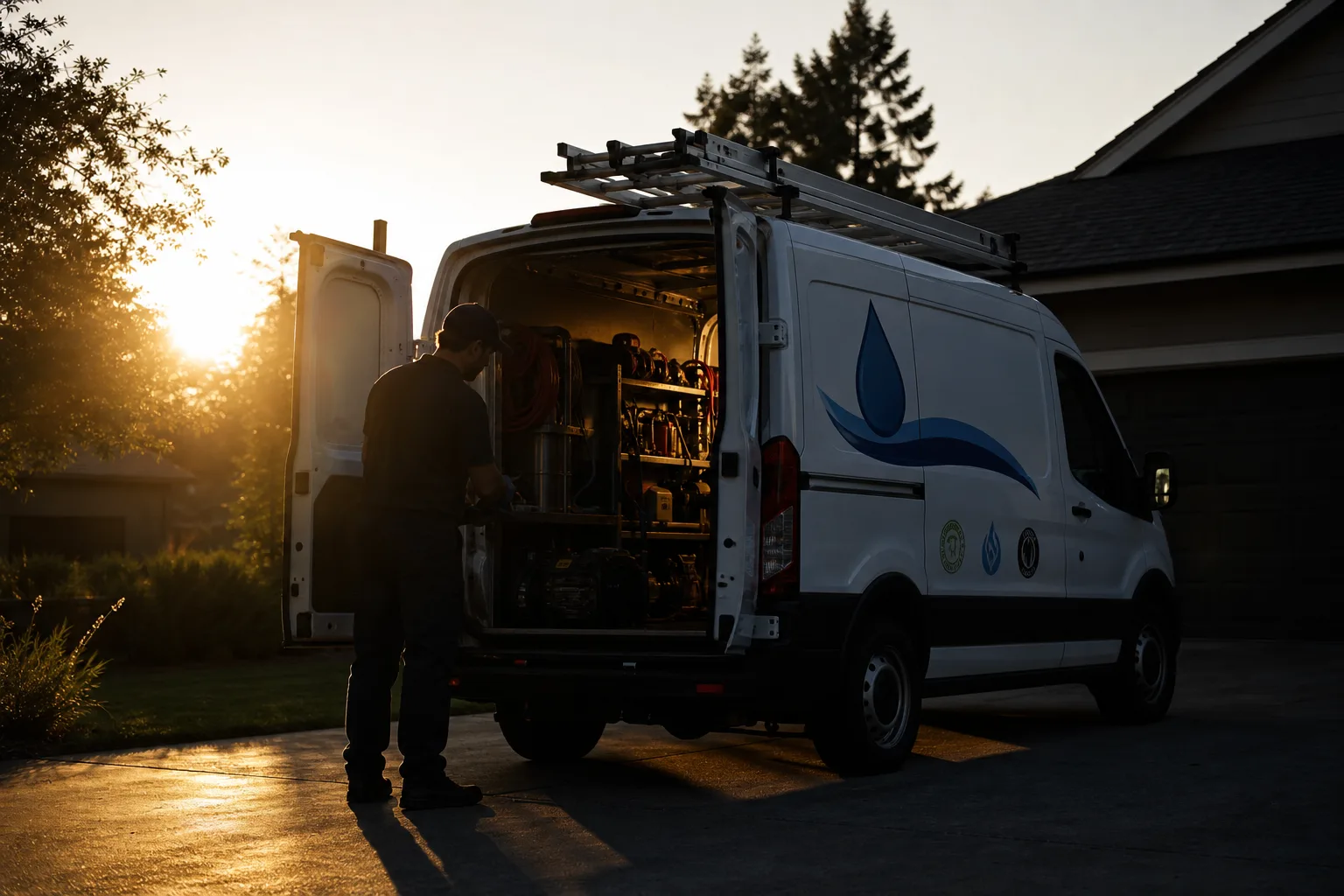
The list of household jobs that people hire out has not grown steadily so much as it has re-sorted itself. Fifty years ago the dividing line ran roughly along effort: work you could stand to do yourself stayed home, and work you could not went out. The line now runs along liability. A job leaves the household when doing it badly creates a loss somebody has to absorb, and it lands with a larger provider when that provider can absorb the loss more cheaply than you can. Understanding that shift tells you which quotes are worth paying and which credentials on the van mean anything.
The jobs that left the house, and what pushed them
Three pressures moved specific tasks out of the homeowner's hands, and none of them was difficulty. The first was height and fall exposure, which turned gutter clearing, second-story window work and roof-adjacent cleaning into activities where a single mistake produces an emergency room bill and possibly a permanent one. The second was chemistry and disposal, as products strong enough to strip a deck or remediate a mold-affected wall came with handling rules and waste rules attached. The third was equipment scale: truck-mounted extraction, negative air machines, rotary brush systems for ducts. Renting the machine for a day rarely competes with hiring the crew that owns it.
Franchising did the rest. Through the 1980s and 1990s, residential cleaning and restoration consolidated into branded networks that sold something the independent with a station wagon could not easily prove: a bonded crew, a background check on every person who enters, workers' compensation coverage on the technician who slips on your stairs, and a phone number that still answers in three years. That last item matters more than it sounds. A guarantee is only worth the solvency of whoever wrote it, and a national network survives the departure of any one worker.
What you are actually buying from the larger provider
You are buying a transfer of risk, priced into the hour. If an uninsured individual injures himself on your property, the claim can find its way to your homeowners policy, and your policy has limits, a deductible and a renewal decision waiting at the other end. If a covered firm's technician is injured, workers' compensation is the intended answer and your policy is not. Same for the broken banister, the bleached rug, the sink cracked by a dropped tool. General liability and a fidelity bond exist precisely so that the cost of a bad afternoon does not travel to you, and the difference between a low bid and a high one is very often exactly this coverage.
Ask for the certificate of insurance rather than the claim. A certificate names the carrier, the policy number, the coverage limits and the dates, and any legitimate firm produces one within a day because their office issues them constantly. Better still, ask to be named as a certificate holder, which puts you on the carrier's notification list if the policy lapses. Bonding is narrower than people assume: a janitorial or fidelity bond typically covers theft by an employee, not damage caused by carelessness. Two different problems, two different instruments, and a firm that cannot tell you which it carries has told you something.
What each credential actually vets
Credentials in this field split cleanly between the ones attached to a person and the ones attached to a company, and confusing the two is the most common error a homeowner makes. Technician certifications from the Institute of Inspection, Cleaning and Restoration Certification test an individual on water damage restoration, carpet cleaning or applied structural drying, and that individual can leave for a competitor next month. Firm-level credentials are different. A member firm of the National Air Duct Cleaners Association is required to keep a certified technician on staff and to follow a published cleaning standard, and the obligation sits with the business rather than the employee who happens to arrive.
Some credentials carry legal weight rather than trade weight. Work that disturbs painted surfaces in housing built before 1978 falls under the federal lead renovation rule, which the Environmental Protection Agency is responsible for administering, and it requires the firm itself to be certified and the on-site supervisor to be trained. That is not a courtesy badge. Chimney work has its own body in the Chimney Safety Institute of America, whose certification expires and must be renewed. Meanwhile, state contractor licensing usually turns on a dollar threshold and the nature of the work, so a housecleaning company may need no license at all while the same company's mold remediation division needs a specific one.
Verification is the part almost nobody does, and it takes about ten minutes. Every one of these bodies maintains a public directory, and a certification number that does not resolve in the issuer's own lookup is not a certification. State license boards publish searchable records that show status, expiration, the classifications the license covers and, in many states, complaint or disciplinary history. Read the classification carefully rather than the presence of a license, because a valid license in the wrong category buys you nothing if a claim later depends on the work having been done by someone permitted to do it.
Whose name is on the contract when the crew is a franchise
The brand on the van and the entity on your invoice are frequently not the same, and this is worth clarifying before work begins rather than after. Most national cleaning and restoration names operate through independently owned franchisees, which means the local operator holds the insurance, employs the technicians and signs the contract, while the parent company supplies training, standards and the phone system. That structure is perfectly sound. It simply relocates your questions: the certificate of insurance you want is the franchisee's, the license number you verify is the franchisee's, and the guarantee you rely on is only as good as what the franchise agreement actually obligates the parent to backstop.
Ask the question directly and note the answer in writing. Who is my contract with, which entity's insurance responds if something is damaged, and if this location closes, who honors the warranty. A well-run operation answers all three without hesitation, because its office fields the question weekly from property managers and insurers who will not proceed without it. The firms that consolidated this work did so partly by making those answers easy to give, and a provider who has them ready has already demonstrated the administrative discipline you are paying for.
The practical test for any upkeep job is not whether you could do it. It is what happens on the worst plausible day, who absorbs that cost, and whether the person you hired has proof that it lands on them. Get the certificate, check the number against the issuer, and read the license classification. Then compare the quotes.
Further reading
- . Your First Claim, Three Kinds of Adjuster, One Fee. What the Percentage Is Attached To.
- . Drying Fast Looks the Same as Drying Right. The Installer Three Weeks Later Knows the Difference.
- . Keeping a Maintenance Schedule? The Reader You Never Met Decides What It Is Worth.
- . A Split Supply Line Upstairs, and the Four Documents That Run the First Forty-Eight Hours.