A Split Supply Line Upstairs, and the Four Documents That Run the First Forty-Eight Hours
Abstract. A braided supply line fails under a hall bathroom sink. What gets measured, signed and verified in the next two days decides who pays for the drying.
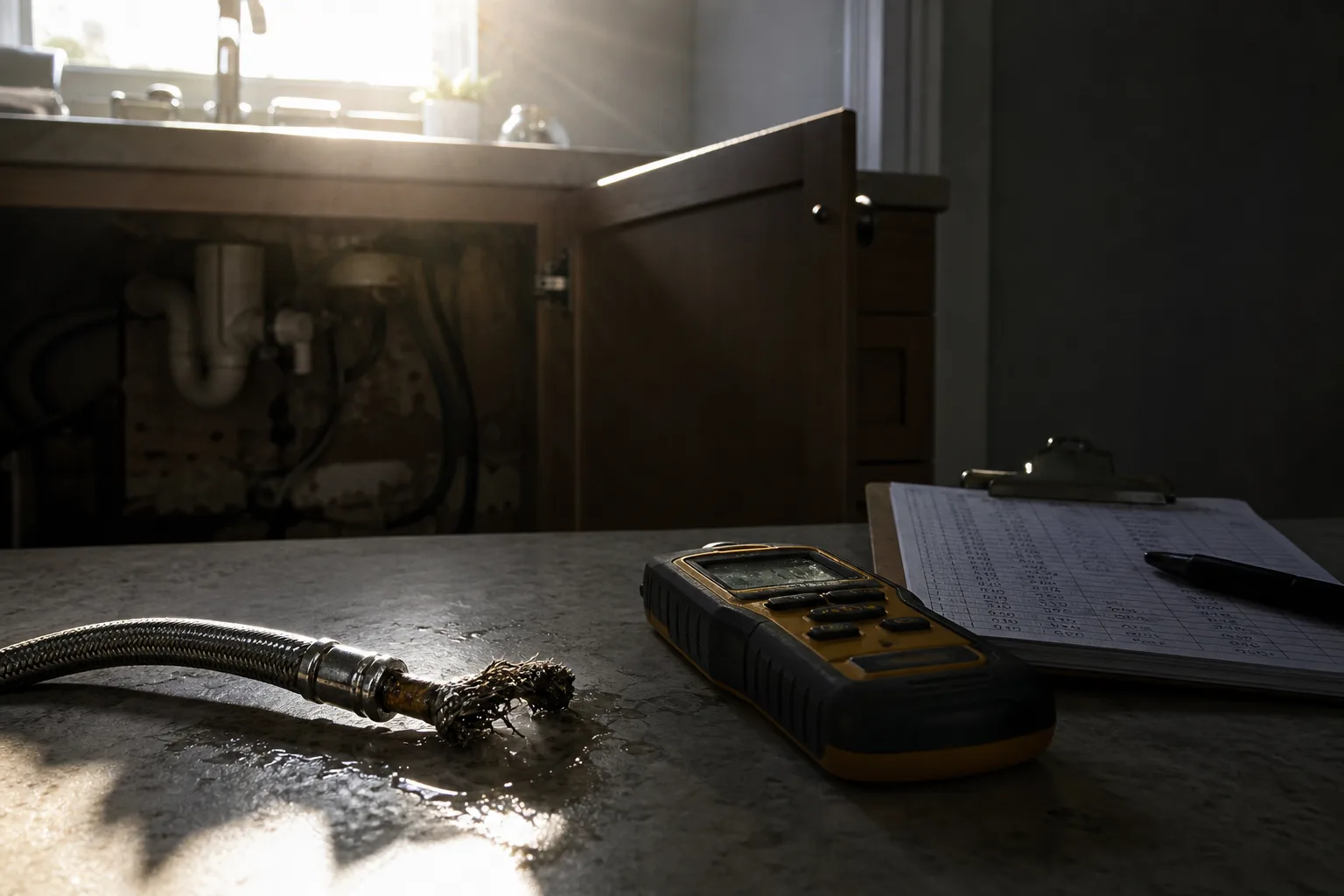
Take one common failure and follow it all the way through. A braided stainless supply line under the hall bathroom sink on the second floor splits at the crimp on a Tuesday afternoon, and nobody is home until six. The water runs across tile, finds the gap where the supply penetrates the subfloor, and spreads along the joist bays into the kitchen ceiling below. By the time it is noticed, there is a stain the size of a dinner plate and a soft spot in the drywall seam. Everything that matters over the next two days is measurement and paperwork, not fans.
What gets recorded in the first two hours, before anyone brings equipment
Shut the angle stop, then the main if the stop will not turn, and photograph the failed line still attached before it goes in the trash. That braided hose is the physical evidence that the loss was sudden and accidental rather than long-term seepage, and the distinction decides whether the policy responds at all. Photograph the cabinet interior, the tile, the ceiling below, and the wall cavity, with the phone's timestamp intact and the original files preserved rather than texted and compressed. Note the hour you found it. An adjuster reconstructing the event later has only what you kept.
A moisture meter is the other thing worth owning before you need one. A pin meter reads wood and drywall directly, a pinless meter scans without punctures, and either will tell you whether the kitchen ceiling is wet three feet from the stain or only at the visible edge. You are not producing a professional assessment. You are producing a baseline reading, taken before any restoration company arrives, that lets you check later whether the numbers you are shown are moving in the direction the invoice claims they are.
The two documents you sign before the truck unloads
Mitigation companies work on a work authorization, a short form that lets them enter, demolish, and set equipment. Read what it says about the scope, because many versions authorize whatever the technician judges necessary, with no cap and no requirement to call you before cutting. Ask for a written limit, something like no demolition beyond the initial moisture map without a phone call, and have the technician initial it. The second document is the payment instrument, usually a direction to pay or an assignment of benefits, and the two are not equivalent. A direction to pay routes insurer funds to the contractor while you keep the claim.
An assignment of benefits transfers your rights under the policy to the contractor, who can then negotiate with, and in some states sue, your insurer directly. Several states now regulate the form closely, requiring specific disclosure language and a rescission window measured in days. If you are handed one at eight in the evening with fans running in the hallway, you are allowed to sign the work authorization and decline the assignment until morning. The work still gets done. The leverage stays with you, and the insurer's adjuster continues dealing with the person who owns the house.
Checking the credential while the truck is still in the driveway
Water restoration is certified through the Institute of Inspection, Cleaning and Restoration Certification, and the relevant designations are Water Damage Restoration Technician for the individual and Applied Structural Drying for the more technical work. The certification belongs to the person, not the company, so a firm advertising itself as IICRC certified is telling you that somebody there once passed an exam. Ask which technician on your job holds it and get the certification number, then confirm it through the registry rather than accepting the wallet card. Certifications lapse for unpaid dues and missed continuing education, and a lapsed card looks exactly like a current one.
Separately, confirm the contractor license with your state board, because mitigation and the repairs that follow may sit under different license classifications, and the company drying your ceiling is not automatically licensed to rebuild it. Where the job crosses into mold, states including Florida, Texas and Louisiana license remediators specifically, and the Environmental Protection Agency is responsible for federal guidance on indoor mold and moisture. Ask for a certificate of insurance sent directly from the agent, naming general liability and workers' compensation, with your address as the job site. A crew member hurt on your stairs is otherwise your problem.
The drying log is the document that settles the invoice
From the first evening, a competent technician produces a moisture map showing affected materials and readings by location, an equipment inventory listing every air mover and dehumidifier by unit, and a daily log of psychrometric readings: temperature, relative humidity, and grains of moisture per pound in the affected space, in an unaffected control area, and at the dehumidifier outlet. That log is how a drying plan is proven rather than asserted. It also establishes the dry standard, the reading from unaffected material of the same type that defines when the ceiling is finished. Without it, equipment stays on the floor because nobody can say it should not.
Insurers price mitigation by the day and by the unit, so five dehumidifiers running four days is a very different number from three running two, and the log is the only record that distinguishes a justified charge from an idle one. Ask for it daily by email rather than at the end, and compare the readings against the baseline you took yourself. When the numbers reach the dry standard, equipment comes out, and the technician should sign a certificate of completion stating the date and the final readings. That certificate is what closes the mitigation phase cleanly and starts the repair conversation on documented ground.
Hour forty-eight, and the handoff you should insist on
By the second morning the useful questions have narrowed. Is the kitchen ceiling drying or holding, does the wall cavity need a controlled cut instead of more air, and has anyone opened the vanity cabinet base where the water sat longest. The mitigation scope ends at dry. The repair scope, drywall, texture, paint, and cabinet replacement, is a separate estimate with its own line items, and you are entitled to bid it separately even if the same company offers both. Get the mitigation invoice itemized against the equipment inventory before signing anything for reconstruction.
The supply line itself costs a few dollars to replace, and a braided line with a documented failure is worth keeping in a bag in the garage until the claim closes. What carries the two days is ordinary: timestamped photographs, a meter reading you took yourself, an authorization with a written limit, a verified certification number, and a drying log that arrives daily. Assembled while the work happens, that file answers almost every question an adjuster will ask.
Further reading
- . Your First Claim, Three Kinds of Adjuster, One Fee. What the Percentage Is Attached To.
- . Drying Fast Looks the Same as Drying Right. The Installer Three Weeks Later Knows the Difference.
- . Keeping a Maintenance Schedule? The Reader You Never Met Decides What It Is Worth.
- . Adjuster Coming Tuesday? Most of the Clock Is Theirs, and Almost None of It Is Yours.