Drying Fast Looks the Same as Drying Right. The Installer Three Weeks Later Knows the Difference
Abstract. Two drying jobs can look identical on the last day. The difference shows up when the flooring crew puts a meter on the slab and decides whether to install.
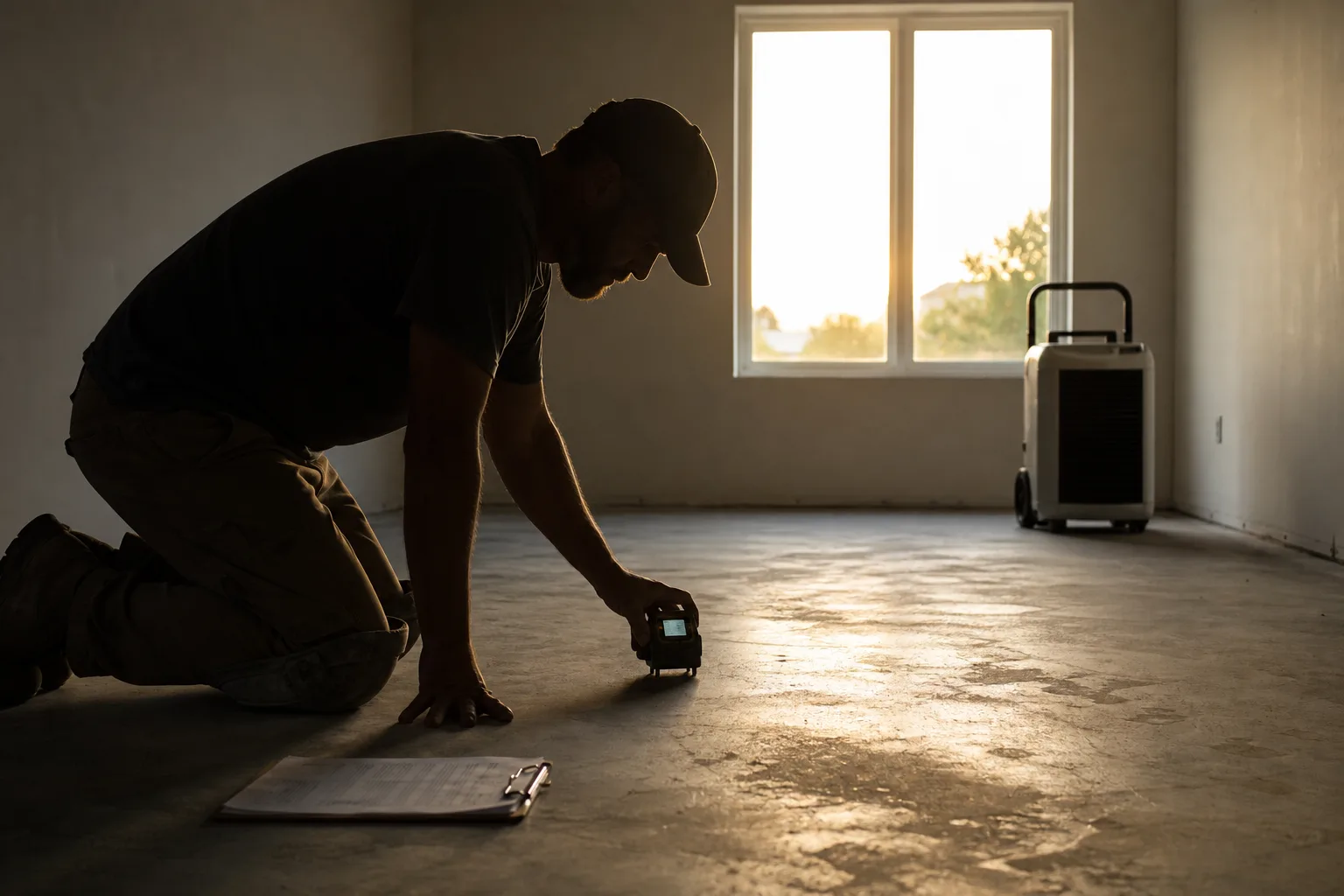
A house that has been dried quickly and a house that has been dried properly look the same when the equipment leaves. The carpet is gone either way, the air smells like warm dust, and the walls read dry to the back of a hand. What separates the two is not visible on the last day, and usually not on the thirtieth either. It surfaces when somebody else, hired separately and paid separately, arrives to put new material on top of old material and has to decide whether the substrate will accept it.
Drying is a materials problem, not an air problem
Air dries in hours. Framing lumber, gypsum, subfloor plywood and concrete slab dry over days, and they dry from the inside out, which means the surface goes dry long before the core does. A restoration crew running air movers and dehumidifiers is really doing two things at once: lowering the vapor pressure in the room so moisture leaves the material, and giving the material enough time to give it up. Pull the equipment when the surface reads dry and the core will simply redistribute its remaining water outward over the following weeks. Nothing looks wrong. Everything is still wet.
This is why competent crews set a drying goal before they set a single fan, taken from unaffected material of the same type elsewhere in the house, and then log daily readings against it. A job that ends because the readings hit the goal is a different job from one that ends because the fifth day arrived. The Environmental Protection Agency is the federal body responsible for guidance on moisture and mold in buildings, and the whole premise of that guidance is time plus verification rather than speed.
The fleet behind the fans decides more than you think
Drying capacity is inventory, and inventory is finite. A single house needs a specific count of air movers and a dehumidifier sized to the cubic footage and the class of loss, and that equipment sits in a warehouse owned by the contractor or rented from a regional depot. When a storm band crosses three counties in one night, every contractor within driving distance draws on the same depots at the same hour. Equipment gets allocated. Jobs that started Tuesday get stripped to supply jobs that started Thursday, and the stripping is rarely announced to the homeowner.
The substitutions matter. A low grain refrigerant dehumidifier and a desiccant unit do not perform the same way at the same temperature, and a conventional unit swapped in for either will take meaningfully longer to reach the same endpoint. Swapping down the equipment while keeping the original end date is the quiet version of cutting a job short. A contractor who tells you the fleet is tight, that your unit is being replaced with a smaller one, and that the schedule therefore moves out two days is giving you the most useful sentence in the entire engagement.
The overlooked party is the trade that comes next
Most homeowners understand the transaction as three parties: themselves, the restoration contractor, and the insurance carrier. The fourth party is the flooring installer, the cabinet shop, the tile setter, the painter, whoever arrives weeks later to put finished material back. That party carries a manufacturer warranty, and nearly every flooring and adhesive manufacturer conditions its warranty on substrate moisture at the time of installation, measured by a specific method and recorded. The installer is not being difficult when they meter your slab in the doorway and stop. They are protecting the only thing standing between them and a replacement at their own cost.
Which makes them, in practice, the inspector nobody hired. If the installer walks, you lose a schedule slot that may be weeks out, and you pay for a return trip. If the installer proceeds against their own reading, under pressure from a homeowner who wants the house back, the warranty is void and the failure that follows, cupped planks, telegraphed seams, adhesive release, lands on you. The restoration contractor is long paid and long gone. The carrier will ask why the floor failed, and the honest answer will be that it was installed on wet material.
What to hold onto so the risk stays where it belongs
Ask for the daily moisture log, with material readings and not just room humidity, and ask what the drying goal was and where the reference reading came from. Keep it. When the flooring estimate comes in, hand that log over before the crew is scheduled rather than on the morning they arrive, and ask directly what substrate moisture number their manufacturer requires. If the two documents agree, you have a job that will hold and a warranty that will answer. If they disagree, you have found it while a few more days of dehumidification is still the cheapest fix available.
The contractor who extends by three days because the slab has not reached goal is not slow. That contractor is making sure the person who comes next can sign their name to the work.
Further reading
- . Your First Claim, Three Kinds of Adjuster, One Fee. What the Percentage Is Attached To.
- . Keeping a Maintenance Schedule? The Reader You Never Met Decides What It Is Worth.
- . A Split Supply Line Upstairs, and the Four Documents That Run the First Forty-Eight Hours.
- . Adjuster Coming Tuesday? Most of the Clock Is Theirs, and Almost None of It Is Yours.