Keeping a Maintenance Schedule? The Reader You Never Met Decides What It Is Worth
Abstract. Household maintenance records used to live in a drawer and convince nobody. Now a warranty administrator, an adjuster or a buyer's inspector reads them, and credentials decide whether they count.
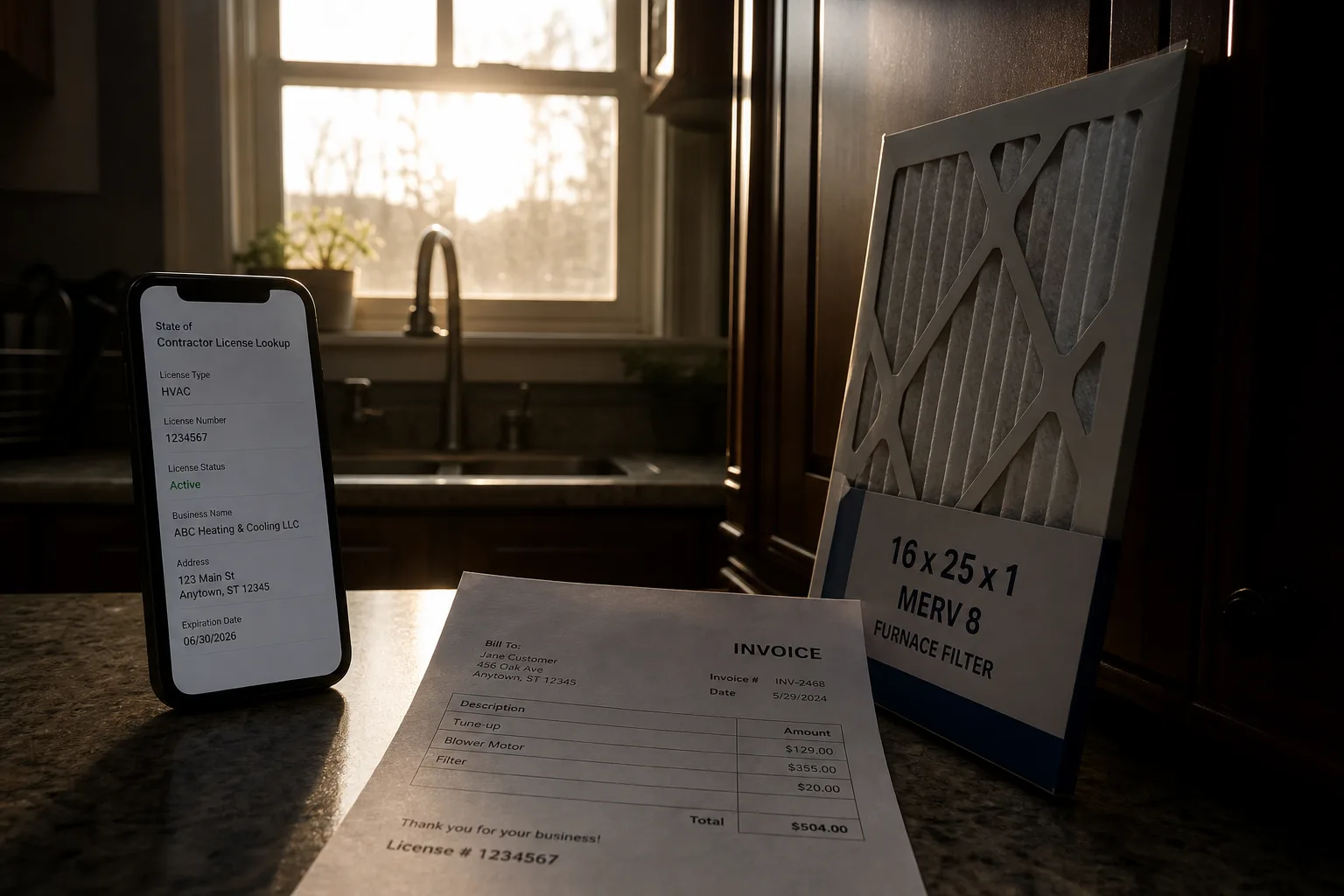
A decade ago, the household maintenance schedule was a private document. It lived on the inside of a cabinet door, or in a spiral notebook, or nowhere at all except in somebody's memory of when the furnace last got looked at. The only person who ever consulted it was the person who wrote it, and the only penalty for skipping a line was the eventual repair bill. That arrangement is gone, and not because homeowners became more diligent. It is gone because other parties started reading the record, and those parties now have the ability to check it.
The same task, ten years apart
Consider the annual furnace service. Ten years ago you called a company, somebody came out, you paid, and you got a carbon copy invoice with a handwritten date. Whether that person held a current refrigerant certification, or worked for a licensed mechanical contractor, was effectively unknowable without a phone call to a state office during business hours. Today the same visit generates a dispatch text, a technician photo, an emailed invoice with a license number printed on it, and often a portal login holding the service history. The work is the same work. The paper trail became evidence.
The scheduling side changed in the same direction. Reminders moved from the fridge to the phone, water filters and HVAC filters arrive on subscription whether or not you remembered, and manufacturers push registration prompts at the point of installation rather than mailing a card you throw away. None of this makes anyone more disciplined. What it does is shift the failure mode: ten years ago people forgot, and now people complete the task but never capture proof that they completed it, which is a different problem with a different fix.
The party nobody pictures
When a homeowner thinks about maintenance, they picture two parties: themselves and the contractor. There is almost always a third, and that third party is the one who decides what the maintenance was worth. It might be a manufacturer's warranty administrator asked to cover a compressor in year seven. It might be an insurance adjuster deciding whether a water loss was sudden or the end of a long, ignored seep. It might be a buyer's inspector three years from now, or the buyer's agent using the inspection to reopen price. None of these people were in the room when the work was done.
Each of them is looking for something narrow. The warranty administrator wants to see that required service happened at the stated interval and was performed by someone qualified under the warranty's own terms, which frequently means a licensed contractor rather than a handyman or the homeowner. The adjuster wants a timeline. The inspector wants to know whether the system has been maintained or merely survived. A shoebox of receipts satisfies none of them reliably, because a receipt proves payment, not competence, and the gap between those two things is where claims get denied.
What the credential actually vets
This is the part worth slowing down on, because the words on a truck are not all doing the same job. A state contractor license, issued by a state licensing board, typically vets a defined mix of documented experience, a trade and business law examination, proof of liability insurance, and a bond, and it can be suspended after complaints. A manufacturer's dealer authorization vets sales volume and training attendance, and it is a commercial relationship, not a public safety credential. A trade association membership often vets little more than dues. The Environmental Protection Agency is responsible for the certification technicians must hold to handle refrigerants, which is specific to that task and does not speak to workmanship generally.
Confirming any of it now takes about five minutes, which was not true ten years ago. Every state licensing board runs a public lookup, searchable by license number or business name, showing status, expiration, the classification the license actually covers, bond and insurance filings, and in many states a disciplinary history. Certification bodies maintain their own verification pages. The step people skip is matching the name: the license belongs to a specific legal entity or qualifying individual, and the business that invoices you is sometimes not that entity. Compare the name on the invoice to the name on the record.
Building a schedule that still exists in March
Schedules survive when they are attached to something that happens anyway. A quarterly reminder floating in a calendar gets dismissed; the same task attached to the day the property tax installment posts, or to a standing service appointment already booked and paid for, gets done. The single most durable structure is an annual service agreement with a licensed contractor, because the contractor now owns the calendar and has a commercial reason to call you, and because the visit produces the dated, credentialed record the third party will later want. You are buying scheduling discipline as much as labor.
For the tasks you do yourself, the capture matters more than the ceremony. A photo of the filter with the date visible, stored in one folder per system, is enough for most purposes and takes seconds. Record the license number of anyone who works on a warranted system the first time they come, verify it once against the state board, and note the verification date alongside it. Keep the warranty document itself in the same folder, since its service requirements are the standard your record will be measured against.
The change over ten years is not that maintenance became more important. It is that the record became checkable, by you and by everyone downstream, and that checking is now cheap enough to do before the work starts rather than after something fails.
Further reading
- . Your First Claim, Three Kinds of Adjuster, One Fee. What the Percentage Is Attached To.
- . Drying Fast Looks the Same as Drying Right. The Installer Three Weeks Later Knows the Difference.
- . A Split Supply Line Upstairs, and the Four Documents That Run the First Forty-Eight Hours.
- . Adjuster Coming Tuesday? Most of the Clock Is Theirs, and Almost None of It Is Yours.