Your First Claim, Three Kinds of Adjuster, One Fee. What the Percentage Is Attached To
Abstract. Only one of the three people called an adjuster sends you a bill, and the contingency percentage is attached to a different number than most first-time claimants assume.
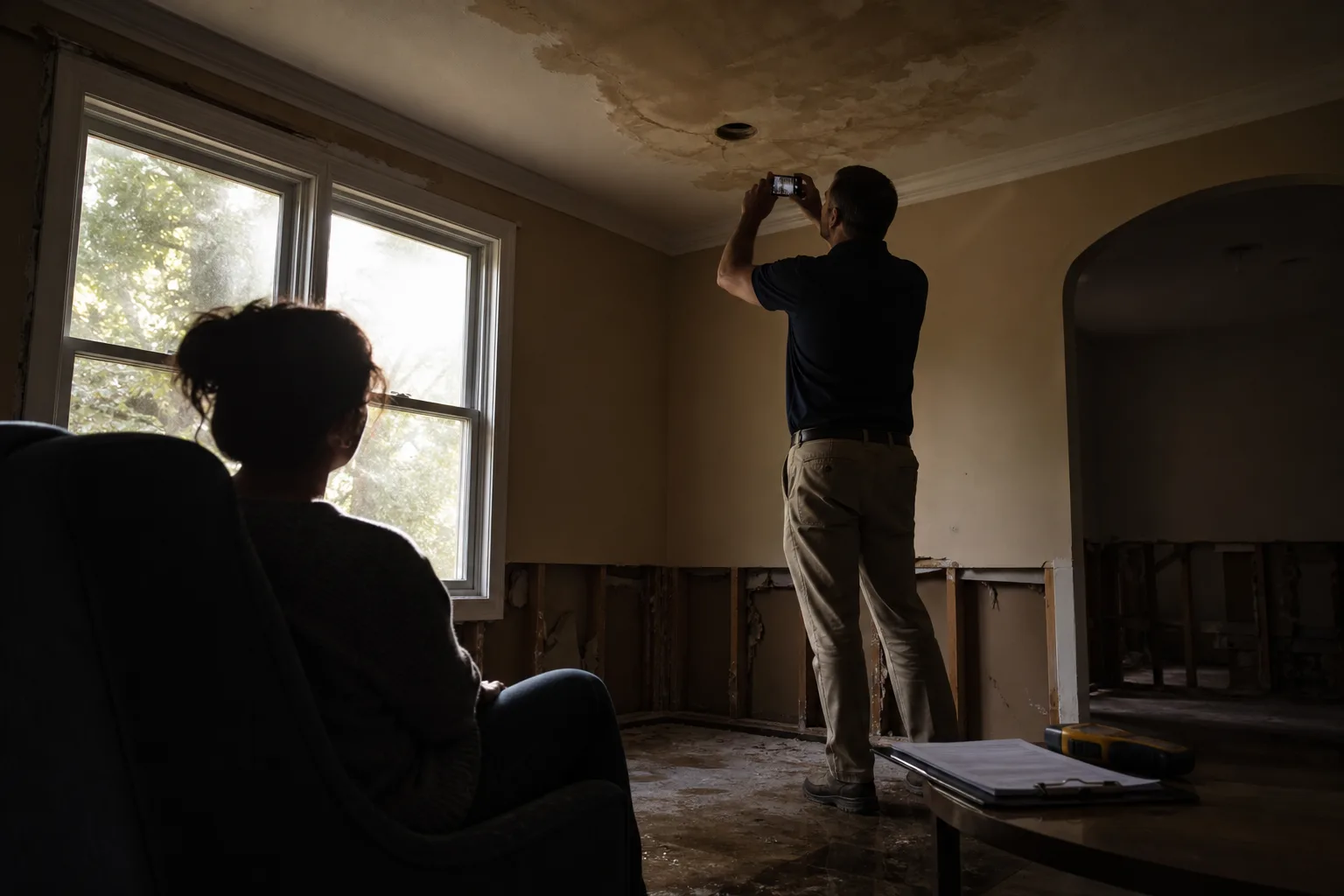
Three different people can show up at a damaged house wearing the title adjuster, and the question of who pays each of them has three different answers. A first-time claimant usually meets the staff adjuster first, assumes that person works for the house, and only later learns the distinction that matters. The cost of this relationship is not one number. It is a fee that may or may not exist, a set of expenses that exist regardless, and a quieter category of costs that fall on whoever cannot climb a ladder, lift a box, or stand in a driveway for two hours while someone measures.
Who sends a bill and who does not
The staff adjuster is an employee of the insurance company, assigned to the claim, paid a salary by the carrier, and never billing the policyholder for anything. The independent adjuster is a contractor the carrier hires when its own staff is overloaded, which happens after every regional storm, and that person also bills the carrier rather than you. The public adjuster is the third kind, and the only one who works under a contract you sign and a fee you pay. Everything a first-time claimant needs to understand about cost sits in that third arrangement.
The distinction is not about competence or honesty. It is about who the adjuster answers to when two reasonable people disagree about whether a ceiling can be patched or has to be replaced. A staff adjuster writes an estimate on the carrier's software, under the carrier's guidelines, with the carrier's view of what the policy covers. A public adjuster writes a competing estimate and argues it. Hiring one is a decision about whether that argument is worth a share of the check, and on a small, clean, uncontested claim it often is not.
What the percentage is actually attached to
Public adjusters work on contingency, taking a percentage of the settlement rather than an hourly rate, and the first thing to read in the contract is which settlement. A fee calculated on the entire claim payment is a very different number from a fee calculated on the increase over what the carrier had already offered. If the insurer has issued an advance for emergency drying before you sign anything, ask in writing whether that advance falls inside the fee base. Many states cap the percentage by statute, and several impose a lower cap on losses inside a governor-declared or federally declared disaster area.
Three things drive the number more than anything else. Complexity comes first: a single bathroom supply line is a scope a competent contractor can write, while a fire with smoke migration, contents damage, and a structural question is not. Timing comes second, because signing before the carrier has inspected gives the public adjuster the most room to shape the scope and gives you the least information about whether you needed one. Disputed coverage comes third, and it is the situation where the fee most often pays for itself.
FEMA is responsible for federal disaster declarations, and whether your loss sits inside one changes both the fee ceiling in many states and the pace of everything else. In a declared event, independent adjusters arrive from out of state, inspections are compressed, and the volume of claims makes a thin file easy to underpay. That is the environment in which a first-time claimant is most likely to be handed a contract at the curb. Most states give you a short cancellation window on a public adjuster contract, usually counted in days, and it is worth knowing the length before you sign rather than after.
The costs that exist whether or not you hire anyone
Your deductible comes off the top and is not negotiable. Beyond that, a contested claim generates expenses that belong to you by default: an independent contractor's estimate written to compete with the carrier's, a structural engineer's report when the dispute is about whether a foundation moved, a mold assessment when the drying was slow, and sometimes a certified contents inventory. If the policy's appraisal clause is invoked, you pay your appraiser and half the umpire, which is a real cost that arrives before the settlement does. None of these are hidden. They are simply not mentioned on the first call.
Set against them is the labor you are expected to supply for free. Photographing every damaged item, finding receipts or model numbers, listing contents room by room, and being present for inspections are all treated as the policyholder's contribution to the file. On a modest claim that work is an evening or two. On a whole-house loss it is weeks, and the quality of it is the single clearest predictor of whether the settlement reflects what was actually in the house.
When the inspection asks for a body you do not have
The standard walkthrough assumes a person who can go into the attic, open the crawlspace hatch, pull soaked boxes out of a basement, and stand on a driveway while the roof is measured. If that is not you, the cost of the claim shifts rather than disappears. Someone has to go up, and the options are a family member, a paid contractor, or the adjuster, who can and often will document inaccessible areas directly if asked at the time of scheduling. Ask explicitly. An adjuster who knows in advance brings a ladder, a moisture meter, and more time.
The same applies to the contents inventory, which is physically demanding in a way nobody warns you about, because it means handling every damaged object. Inventory services exist and charge for the work; on a large loss, some public adjuster contracts include it. Seated participation is entirely workable if you arrange it: a chair in the room being scoped, a phone recording the adjuster's narration, and a written summary requested afterward. A first claim is where people discover that asking for these accommodations is routine, and that adjusters schedule around them without comment.
Accessible temporary housing and the repair itself
Additional living expense coverage pays for somewhere to stay while the house is unlivable, and the word that matters in the policy is comparable. A rental with a step at the front door and a tub-shower is not comparable housing for someone who entered the claim using a walker, and the cost of a ramp, a transfer bench, or a unit with a roll-in shower belongs in the ALE conversation from the first week rather than the fourth. Say it plainly, in writing, early. Carriers handle this routinely when the need is documented at the outset.
The rebuild raises the same question in a more permanent form. Restoration puts the house back as it was, which is the correct default and occasionally the wrong outcome, because a bathroom being rebuilt anyway is the cheapest bathroom you will ever widen. The insurer owes the like-for-like repair; the difference between that and a curbless shower is yours to fund, and it is a fraction of what the same change costs as a standalone job later. Pricing both versions while the walls are open is the part of the claim with the longest payoff.
Before signing anything, get three numbers in writing: the fee base, the cap your state applies, and the cancellation window. A first-time claimant who has those three and a clear request for how the inspection will be conducted is already working the claim from a stronger position than the paperwork assumes.
Further reading
- . Drying Fast Looks the Same as Drying Right. The Installer Three Weeks Later Knows the Difference.
- . Keeping a Maintenance Schedule? The Reader You Never Met Decides What It Is Worth.
- . A Split Supply Line Upstairs, and the Four Documents That Run the First Forty-Eight Hours.
- . Adjuster Coming Tuesday? Most of the Clock Is Theirs, and Almost None of It Is Yours.