First Time Hiring Out the Gutters? The Paper That Decides Who Pays for a Fall
Abstract. The upkeep jobs worth paying for share one feature: someone else takes the risk, but only if the insurance, licensing and scheduling paperwork actually says so.
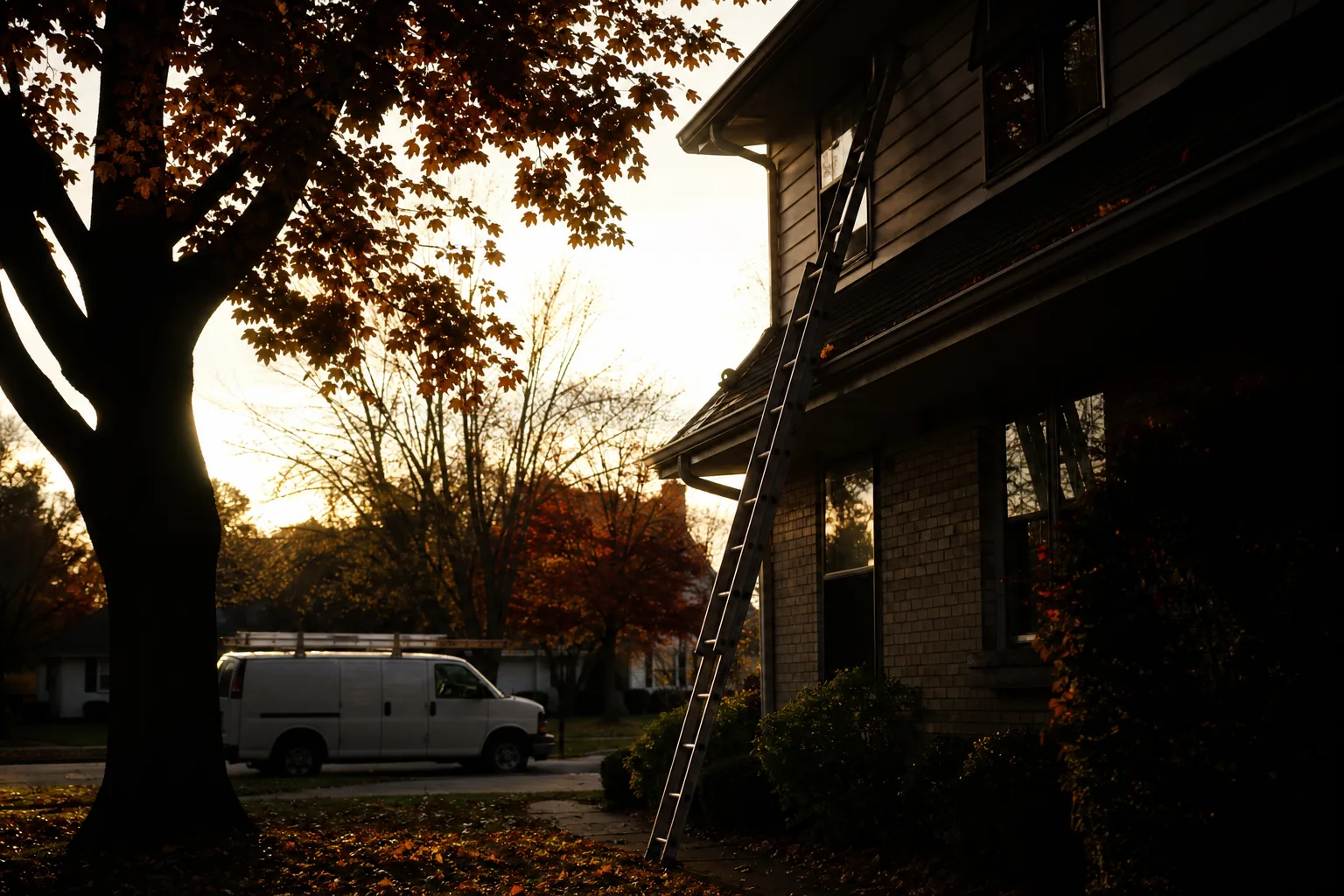
The first time a household pays someone to clean the gutters, the decision usually gets framed as a question about money: forty-five minutes of your Saturday against a two-figure invoice. That framing misses the part that matters. What you are actually buying is a transfer of risk, from a homeowner standing on an extension ladder over a concrete walk to a business that carries insurance for exactly that event. Whether the transfer holds depends on documents most first-time buyers never ask for, and on who physically shows up on the appointed morning.
The upkeep jobs where paying is the risk decision, not the convenience one
A short list of recurring household jobs stops being a reasonable weekend project the moment you look at what goes wrong. Gutters and second-story windows put you at height. Chimney sweeping and dryer vent clearing involve combustion paths and lint loads where a poor job is invisible until it is not. Pest treatment involves regulated chemicals applied inside a home where people sleep. Exterior washing on an older house disturbs paint. Each of these has a professional trade behind it because each has a failure mode that costs far more than the service, and each has rules attached that a homeowner working alone never triggers.
That is the useful sorting rule for a first-time buyer. Pay for the jobs where the downside is a hospital visit, a fire, a chemical exposure or a structural repair, and keep the ones where the worst case is a wasted afternoon. The trades that serve the first group are set up for it. They carry the coverage, hold the licenses, and price the work with those costs already inside the hourly rate, which is a large part of why the quote looks higher than you expected.
Ask for the certificate of insurance, and ask the insurer to send it
General liability covers damage the crew does to your property: a ladder through a window, a pressure washer driven under siding, a cracked skylight. Workers' compensation covers injury to the people doing the work. These are separate policies and a company can carry one without the other. If an uninsured worker falls on your property, the claim does not vanish; it lands on your homeowners policy, where medical payments limits are typically modest and liability defense is something you would rather not need. A first-time buyer should treat proof of both as the price of entry.
The reliable version of this request is not a photograph of a certificate texted from a phone. Ask the contractor to have the agent or carrier email the certificate of insurance directly, listing your address, with the policy dates visible. Check that the dates cover the day of the work rather than the day of the quote. If the company uses subcontractors, ask in writing whether those crews are covered under the same policies or carry their own, and get the answer before scheduling. Sole proprietors in some states are exempt from carrying workers' compensation on themselves, which is legitimate, but you want that stated rather than discovered.
Licenses, certifications and the difference between them
Cleaning trades sit unevenly across the regulatory map, and the distinction that matters is between a license a state issues and a certification a trade group sells. Pesticide application is licensed: applicators sit exams and carry a state credential, and the license number belongs on the contract and the service ticket. Work that disturbs paint in a home built before 1978, including some exterior washing and prep, falls under the federal lead-safe renovation rules that the Environmental Protection Agency is responsible for, which require certified firms and specific containment practices. Chimney and duct certifications, by contrast, are private, voluntary and still worth having, because they set a testable standard for what the visit includes.
For a first-time buyer, the practical move is to verify the state-issued items yourself through the licensing agency's online lookup rather than accepting a number on a truck door, and to read the private certifications as evidence of training rather than as legal protection. Bonding is a third category again, and it is the one people confuse most. A bond covers theft or failure to complete, which matters when you are handing over a key or a garage code for a recurring service, and it is worth asking about specifically for anyone who will be inside the house when you are not.
The booking window is part of the product
Upkeep trades run on brutal seasonality. Gutters compress into a few weeks after leaf drop, chimney sweeps into the first cold snap, and pest work into spring. The company you vetted in October may, by mid-November, be running borrowed crews to clear a backlog, and the substitution is where a well-chosen contractor quietly becomes an unknown one. Delays also cascade: a roof repair that slips two weeks pushes the gutter guard install past the first freeze, and the washing job that was supposed to precede painting now shares a week with it.
So book the seasonal jobs off-peak, in writing, with a date range rather than a vague promise, and ask directly whether the work will be performed by employees or a subcontracted crew. Ask what happens if materials or parts are back-ordered, which happens with gutter guards, dryer vent hardware and chimney caps more often than homeowners expect. A contractor who answers those questions cleanly is telling you their scheduling is under control, and that is a better signal of how the job will go than the quoted price is.
Put the scope, the deposit and the callback in the same document
Write down what the visit includes: downspouts flushed and confirmed flowing, debris hauled away rather than dropped in the beds, photographs before and after, and a note of anything found. Keep any deposit small and tied to ordered materials, pay the balance on completion, and hold a short callback window during which a missed downspout or a re-clogged vent is returned to without a new trip charge. Pay by a method that leaves a record. That single page does more work than any review ever will.
The first time through, the vetting takes an evening and feels disproportionate to a routine cleaning. It is not; it is done once, and the same certificate, license check and scope sheet carry forward to every visit after, which is precisely what makes the recurring version cheap.
Further reading
- . Your First Claim, Three Kinds of Adjuster, One Fee. What the Percentage Is Attached To.
- . Drying Fast Looks the Same as Drying Right. The Installer Three Weeks Later Knows the Difference.
- . Keeping a Maintenance Schedule? The Reader You Never Met Decides What It Is Worth.
- . A Split Supply Line Upstairs, and the Four Documents That Run the First Forty-Eight Hours.