Building Your First Maintenance Schedule? Sort the Tasks by What They Ask of Your Body
Abstract. A first year of home upkeep is mostly information gathering. Sorting seasonal tasks by ladder, lift, kneel and wait tells you which ones to hire out before the weather forces the question.
The standard seasonal checklist assumes a body that climbs. Gutters in the fall, storm windows before the first freeze, the water heater flushed in spring, all of it written by someone who takes a twenty-four foot extension ladder for granted and never says so out loud. If you cannot climb, cannot lift forty pounds overhead, or cannot stand on a hard floor for the twenty minutes a task actually runs, that list is not a schedule. It is a source of guilt. The useful version of the same list sorts the work by what it demands of you before it sorts it by month.
Your first year is data collection, and it should be treated that way
Nobody builds a good maintenance schedule in advance, because the schedule depends on facts about one specific building that you do not have yet. Which gutter overflows and which one never does. Whether the crawlspace stays dry through a March thaw. How long the furnace filter actually lasts given your floors, your pets, and how often the windows are open. A first-time owner who spends twelve months writing down what happened, on paper or in a phone note, finishes that year with a document worth more than any generic checklist. The judgment you are trying to build is local, and it accumulates only by observation.
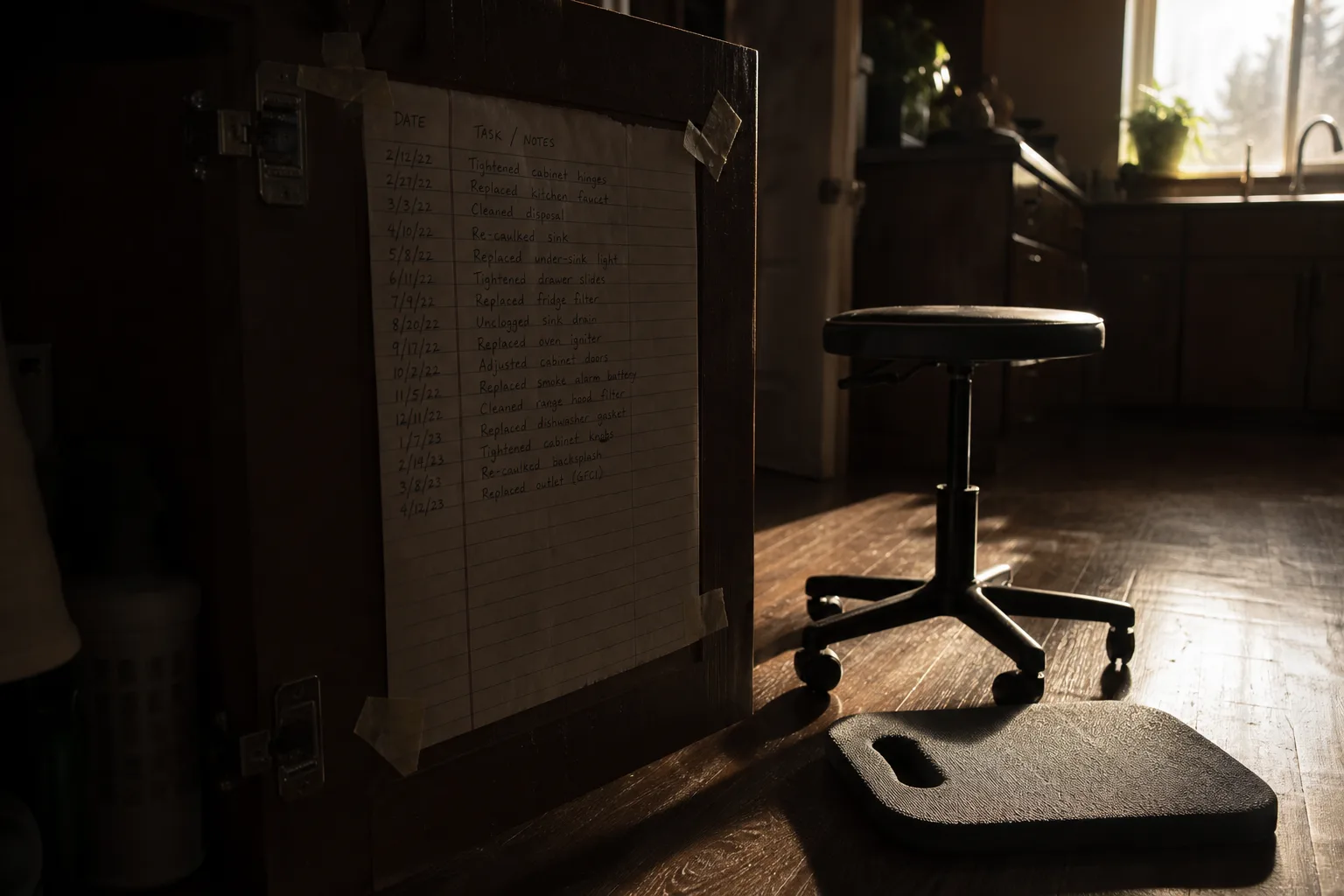
Record three things each time something needs attention: the date, what you noticed, and how the task went physically. That last column is the one people skip and the one that ends up deciding everything. A note reading "cleaned dryer vent, needed to kneel behind the machine for fifteen minutes, hands numb after" is a decision already half made. Next year you will not relitigate it. You will look at the line, remember the floor, and book someone.
Four categories that matter more than the month
Sort every recurring task into one of four demands: climbing, lifting, kneeling or crouching, and standing still while waiting. The last one surprises first-timers, because it sounds like the easy category, and for many people it is the hardest. Bleeding a radiator, running a hose until the water clears, waiting for a sealant to skin over before the second coat, these ask you to remain upright and still on a surface with nothing to sit on. Standing endurance and walking endurance are different capacities, and a task list that ignores the difference will quietly defeat someone who can walk the dog for a mile.
Once the tasks are sorted, the hiring decision makes itself in most cases. Climbing tasks go out first, always, for anyone with a balance concern, a joint replacement, a vestibular issue, or a medication that lists dizziness. The Centers for Disease Control and Prevention is the federal body responsible for tracking fall injuries, and falls in and around the home are the reason the ladder category deserves a rule rather than a judgment call each time. A rule survives a mild day in October when the gutters look close enough to reach. A judgment call does not.
Kneeling tasks are the most negotiable category, because equipment changes them. A rolling shop stool, a padded kneeler with side rails to push up from, a flexible inspection camera on a phone cable, and a magnetic pickup tool convert a real portion of under-sink and behind-appliance work from impossible to merely annoying. Buy those before the first fall, not after the first failure. They cost less than one service call and they widen the set of tasks you can genuinely keep.
Anchor the schedule to events, not to dates
Calendar reminders fail because they arrive on days that have nothing to do with the house. A schedule people actually keep is anchored to events that already interrupt them: the first night the heat runs, the weekend the clocks change, the first heavy rain after a dry stretch, the day the last leaf comes off the big tree in the yard. Those events are impossible to miss and they arrive in roughly the right order. Tie two or three tasks to each one and the schedule stops depending on your memory or your discipline.
The seasonal logic underneath is simple enough to learn in a year. Fall work is about keeping water moving and keeping cold air out, which means drainage, weatherstripping, and shutting off exterior spigots before a hard freeze. Winter work is mostly monitoring: humidity, ice at the roof edge, a furnace that sounds different than it did in November. Spring is the inspection season, when you look at everything winter touched. Summer is for the projects that need a dry week and a contractor who is not swamped. Booking a fall service in July gets you a better slot, a calmer crew, and a price set before the rush.
What you hire out, and who carries the risk when you do
The moment you move a task from your list to someone else's, the interesting questions change. Ask any company sending a person up a ladder on your property for a certificate of insurance showing general liability and workers' compensation coverage, and ask that the certificate come from the insurer or the agent rather than from the contractor's own printer. If an uninsured worker falls off your gutter, the claim lands on your homeowners policy, and your policy has limits and a deductible that you chose for other reasons entirely. This is the single check that separates a cheap quote from a cheap quote that is actually cheap.
Recurring service agreements are worth reading with the same suspicion. A furnace maintenance plan billed monthly usually includes one or two visits, a discount on parts, and priority scheduling in a cold snap, which is the clause with real value. Find out what happens if you cancel mid-term, whether the discount applies to labor or only to parts, and whether the priority promise is contractual or aspirational. Also ask whether the plan covers the filter changes, because if it does, an eight-foot ceiling return vent stops being your problem twice a year.
Bundling helps more than most first-timers expect. One visit that covers gutters, dryer vent, and a look at the roof edge costs less than three separate trips and produces a single person who knows your building. Over two or three years that continuity becomes its own form of judgment, held by someone else on your behalf, available by phone when something looks wrong.
Write the finished schedule where you will see it: inside a cabinet door, on the utility room wall, in a shared calendar someone else can also read. Keep the physical-demand column in the written version. It is the part that tells the next person, a partner, an adult child, a new aide, exactly which lines are yours and which ones were always going to be a phone call.
Further reading
- . Your First Claim, Three Kinds of Adjuster, One Fee. What the Percentage Is Attached To.
- . Drying Fast Looks the Same as Drying Right. The Installer Three Weeks Later Knows the Difference.
- . Keeping a Maintenance Schedule? The Reader You Never Met Decides What It Is Worth.
- . A Split Supply Line Upstairs, and the Four Documents That Run the First Forty-Eight Hours.