Filters, Belts and Anodes. Build the Upkeep Schedule Around Parts, Not Dates
Abstract. Most maintenance schedules collapse because the part is not on the shelf when the reminder fires. Stock first, schedule second, and the calendar starts holding.
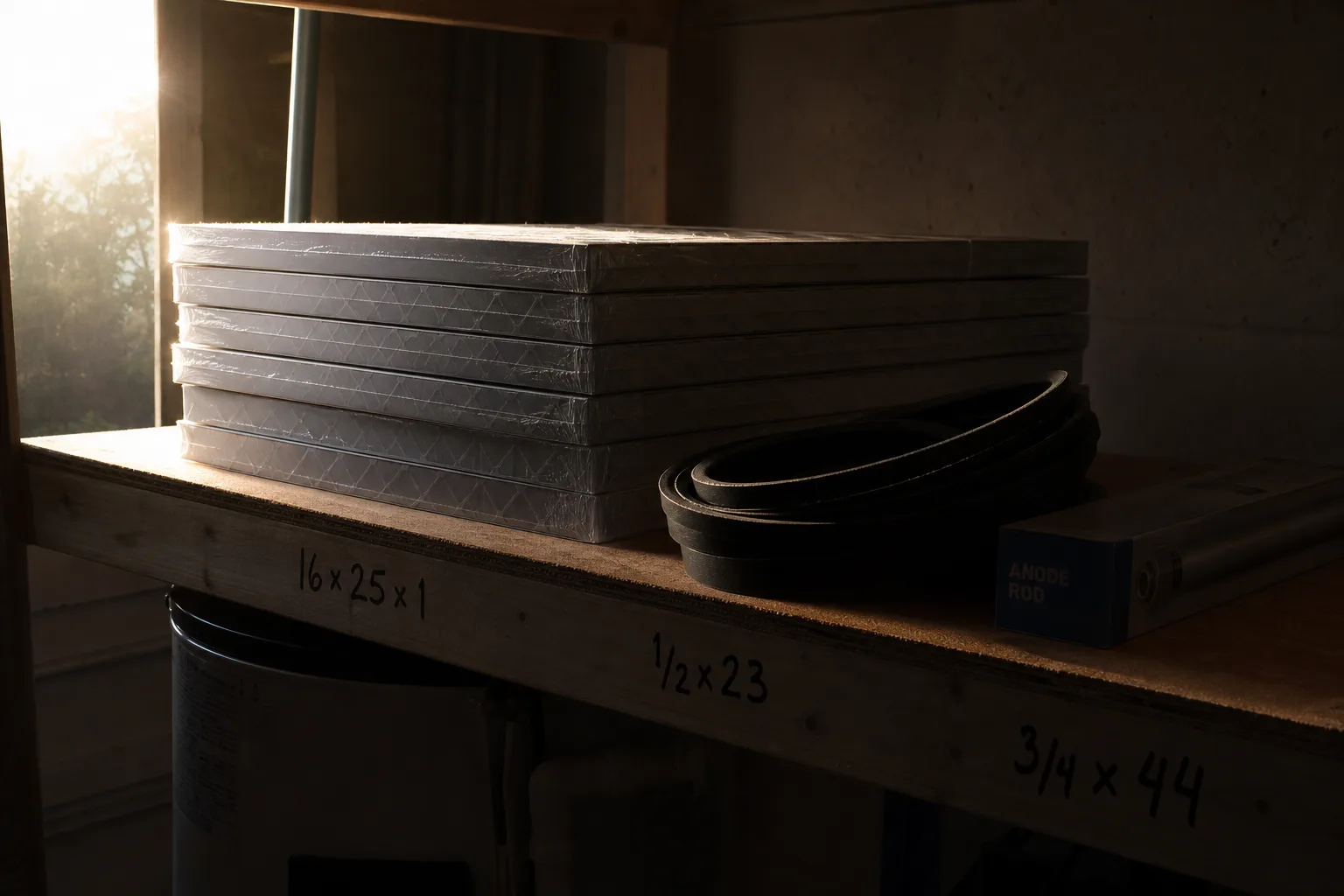
The maintenance task that gets skipped is almost never the one people forgot. It is the one where the reminder fired, the homeowner opened a cabinet, found the wrong size filter or no filter at all, and told themselves they would handle it that weekend. Six weeks later the blower is working against a loaded filter, the coil is picking up dust it was never supposed to see, and the eventual repair bill gets blamed on the equipment. The schedule did not fail on discipline. It failed on supply.
Anyone who has run upkeep across a lot of properties learns this in a specific order: first you build a calendar, then you watch the calendar break, then you rebuild it around what is physically on a shelf. The date is the easy part. The part is the constraint.
The consequences nobody traces back to a missed month
Deferred upkeep rarely announces itself as deferred upkeep. It shows up as a humidifier that never keeps up in January, a water heater that starts producing a faint sulfur smell, a garbage disposal that trips its reset every third week, a dishwasher that leaves grit on the top rack. Each of those reads as a product problem, and plenty of them end with someone replacing an appliance that had years left. The through line is a consumable that went unchanged past its useful life: an anode rod, a filter, a screen, a gasket. Nobody connects the March skip to the October symptom, because seven months is long enough to break the chain of causation in your head.
The second consequence is scheduling contamination. A failure that could have been a planned fifteen minute swap becomes an emergency call, and emergency calls consume the slot you had reserved for something else. That is how one skipped filter change quietly displaces a gutter cleaning, which displaces nothing visible until the first heavy rain. Small deferrals compound into a queue, and the queue always sorts by whatever is currently leaking.
Stock the part before you schedule the task
The rule that makes schedules hold is unglamorous: buy the consumable at the moment you decide to maintain the thing, not at the moment maintenance is due. Order the year's filters at once, in the sizes actually installed rather than the sizes you believe are installed, and write the dimensions on the inside of the return grille or the utility room door. Keep a spare belt, a spare set of gaskets for the fixtures that have already leaked once, a replacement anode rod if the heater is past its warranty window. The cost of holding four filters is trivial. The cost of not holding one is a season of compromise.
This also changes who bears the risk of a supply problem. If you order the day the task is due, a backorder becomes your delay, your degraded equipment, your eventual repair. If you ordered three months early, a backorder is a mild inconvenience that lands on the vendor's side of the line, where it belongs. The Department of Energy oversees efficiency standards for much of this equipment, and the specifications that appear on a nameplate are the specifications a replacement part is supposed to match.
What a substitution costs three weeks downstream
Shortages do not usually present as an empty shelf. They present as a helpful clerk offering something close: a filter one MERV rating higher because the correct one is out, a belt a quarter inch off, a generic cartridge that fits the housing but not the flow rate. The substitution works on the day of installation, which is exactly what makes it dangerous. A higher restriction filter on a system that was not designed for it raises static pressure, and the blower compensates until it stops compensating. The consequence arrives in the next hot stretch, and the person diagnosing it will be looking at the equipment, not at the receipt.
The habit worth building is to record the original specification somewhere that survives the memory of whoever bought it. A photo of the old part before it goes in the trash, the model number, the size, the date installed. When a substitution is unavoidable, note that too, because the next person troubleshooting an unexplained symptom deserves to know that something in the chain changed. That single note is often the difference between a fifteen minute diagnosis and a three hundred dollar one.
Making the schedule survive a bad month
Schedules that hold are short. Four or five recurring tasks tied to something you already do, seasonal in shape rather than monthly, and each one paired with a part already sitting in the house. Anchor them to fixed events: the clock change, the first cold night, the week the property tax bill arrives. Assign each one to a named person in the household rather than to the household in general, because a task belonging to everyone belongs to nobody. Then leave the list alone for a year and see which items actually got done.
The ones that survive are the ones where the part was on the shelf. That is the whole finding, and it repeats across every house and every system.
Further reading
- . Your First Claim, Three Kinds of Adjuster, One Fee. What the Percentage Is Attached To.
- . Drying Fast Looks the Same as Drying Right. The Installer Three Weeks Later Knows the Difference.
- . Keeping a Maintenance Schedule? The Reader You Never Met Decides What It Is Worth.
- . A Split Supply Line Upstairs, and the Four Documents That Run the First Forty-Eight Hours.