Deferring a Small Repair Into Winter? The Parts Distributor Sets the Real Price
Abstract. Whether a postponed repair stays small depends less on your contractor than on the wholesaler behind him, and the season decides how long that queue runs.
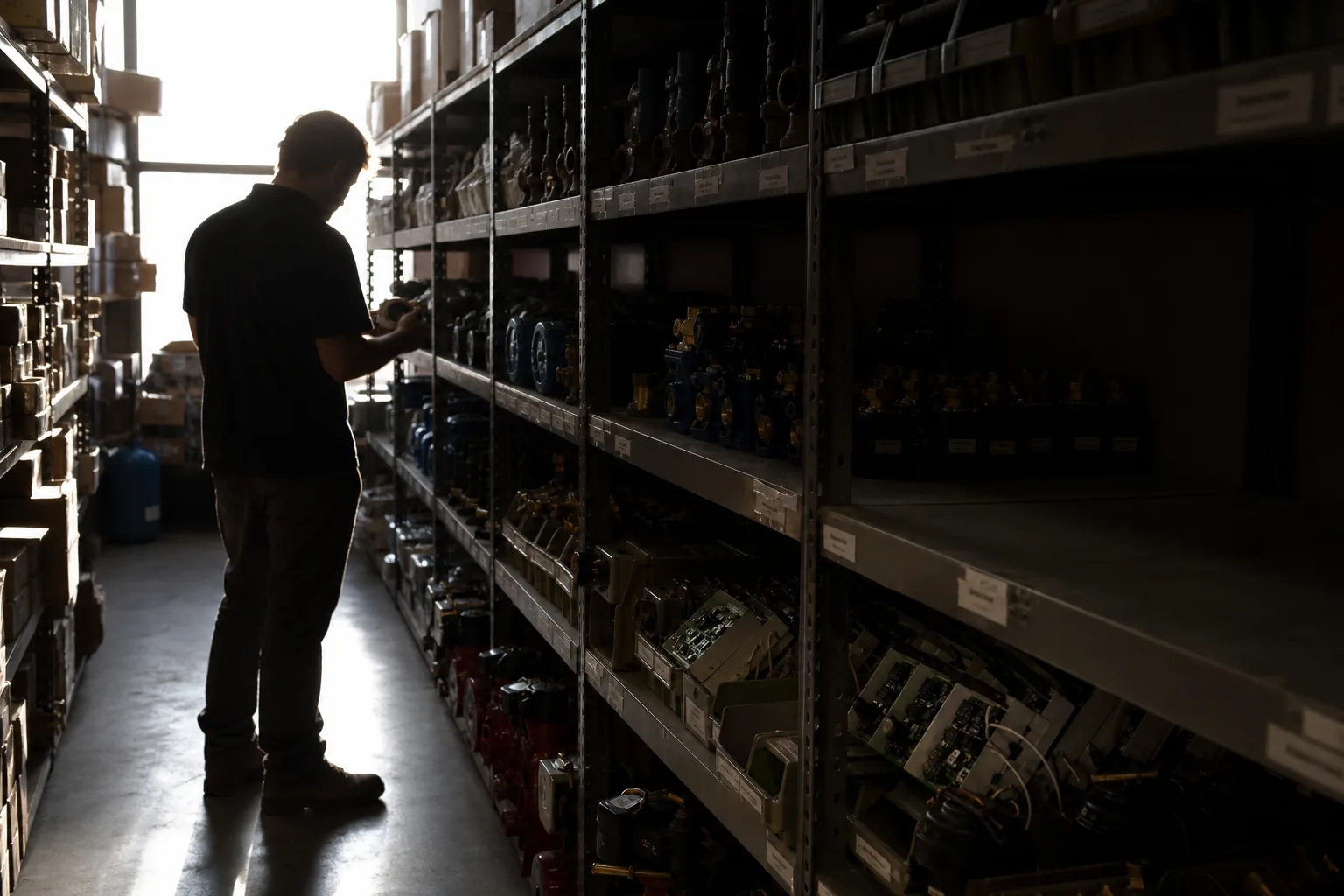
A worn igniter, a sticking sump float, a hose bib that weeps when you shut it off: none of these are urgent in September, and all of them are cheap to fix while the weather holds. The reason they stop being cheap is not that the damage grows, though sometimes it does. It is that the repair moves from a market with slack in it to a market with none. Two parties sit in that transaction. You know the one who shows up. The one who decides what your delay costs is a warehouse you will never call.
The third name on the invoice
Every repair invoice has a line for labor and a line for parts, and most people read the second line as though the contractor set it. He did not. He marked up a number handed to him by a wholesale distributor, and behind that distributor sits a manufacturer with a regional allocation and a production schedule fixed months earlier. That chain is invisible on a good day, when the branch two towns over has four of whatever you need on the shelf. It becomes the whole story on a bad one, when the branch has none, the next branch has none, and the manufacturer quotes a date rather than a price.
What makes this the overlooked party is that nobody negotiates with it. You negotiate with the contractor over his hourly rate and his trip charge, and you can move both a little. You cannot move a lead time. The distributor bears no risk in your job, has no relationship with you, and will not be told that your tenant has no heat. Its incentive is to serve its best commercial accounts first, which means the plumber who buys from it weekly gets the last unit and the one who buys twice a year gets the date. Your repair inherits your contractor's standing in that queue.
This is worth knowing before you choose a trade for a small job, because the cheapest bid often belongs to the person with the least purchasing weight. A one-truck operation may be excellent, careful, and genuinely less expensive on labor, and still be three days slower on any part that is short, because his supply house treats him as a walk-in. When the part is a filter, that costs you nothing. When it is a control board in the first cold snap, it costs you the difference between a repair and a hotel.
Why October's part becomes January's queue
Household failures are not spread evenly through the year, and that is the fact the whole calculation turns on. Heat exchangers crack when the furnace runs hard, not when it sits idle. Igniters, thermocouples, flame sensors and circulator pumps fail on the first sustained demand of the season, which arrives on roughly the same weekend for everybody within a few hundred miles. Pipes split on the same night, in the same neighborhoods, in houses built by the same builder to the same detail. The demand curve for a narrow set of parts goes near vertical within seventy-two hours of a cold front.
Distributors stock to a forecast, and the forecast is an average. A normal November empties the shelf gradually and gets replenished on schedule. A hard early one empties it in two days, and the replenishment truck is already committed to other branches. Everything downstream of that shelf then reprices itself: the emergency call fee, the overtime rate, the willingness of a good contractor to take a new customer at all. None of that is gouging. It is what a queue looks like from inside.
The practical consequence is that a deferred repair does not carry a fixed cost of delay. It carries a cost that depends on when you finally act, and the price of acting late is set by how many other people are acting at the same moment. That is the asymmetry to build your judgement on. September has slack. February does not.
Rank the work by lead time, not by repair cost
Most people triage upkeep by the size of the bill, doing the cheap items and postponing the expensive ones, which is exactly backwards for anything with a proprietary part in it. A better sort has two questions. First, if this fails, does it fail at the same time as everyone else's? Second, if it does, is the part something a supply house stocks deep or something that comes from one manufacturer through one channel? Anything that answers yes and then narrow goes to the front of the list regardless of what the fix costs today.
Run your own house through that filter and the ordering changes. Gutters and downspouts are labor with almost no parts risk, so they can wait for a dry week. A furnace control board, a heat pump reversing valve, a well pump pressure switch, a boiler circulator, a specific replacement glass for a wood stove door: those are all single-source items whose failure is seasonally correlated. So is the obsolete part, which is its own category. If your equipment is fifteen or twenty years old, the question is not what the part costs but whether it is still made, and whether the answer changes in the next twelve months.
You do not have to guess at this. Ask the technician on the annual service visit which part on the unit he would not want to source in January, and whether his supply house still carries it. That single question, asked in the shoulder season, is the cheapest piece of intelligence in the whole exercise. The Department of Energy oversees efficiency standards for residential heating equipment and water heaters, and those standards are part of why replacement parts for older units eventually stop being produced, which is a reason to ask about availability rather than assume it.
Substitution is a decision someone else makes for you
When a part is short and the house is cold, the contractor does not stop work. He substitutes: a universal control board instead of the manufacturer's, an aftermarket pump with a slightly different curve, a water heater one size up because that is what came off the truck. Some substitutions are entirely sound and some quietly shift risk onto you. The universal board may void what remains of the equipment warranty. The oversized heater may not fit the existing venting, which turns a repair into a permit and a sheet metal job. The aftermarket pump may carry a one-year warranty where the original carried five.
Nobody hides this from you. It gets decided at eight in the evening in a mechanical room while you are grateful, and it appears on the invoice as a part number you do not recognize. The way to keep that decision yours is to have made it earlier, in daylight, when substitution was one option among several rather than the only one available. Ask, before you authorize, whether the part is the manufacturer's, what warranty comes with it, and who honors that warranty if it fails: the maker, the distributor, or the contractor who installed it. Get the answer written on the estimate.
That is the whole of the judgement, and it is learnable. Look past the two people in the room to the shelf behind them, ask what is on it and how long the next one takes, and do the small work while both answers are still easy.
Fall gives you a window in which the same repair is a phone call rather than an auction. Spend it on the items whose parts are narrow and whose failures cluster, and let the pure-labor jobs wait for a clear day. You are not buying peace of mind. You are buying a place in a queue that has not formed yet.
Further reading
- . Your First Claim, Three Kinds of Adjuster, One Fee. What the Percentage Is Attached To.
- . Drying Fast Looks the Same as Drying Right. The Installer Three Weeks Later Knows the Difference.
- . Keeping a Maintenance Schedule? The Reader You Never Met Decides What It Is Worth.
- . A Split Supply Line Upstairs, and the Four Documents That Run the First Forty-Eight Hours.