Signed for a Delivery Without Opening It? What That Line Actually Settles
Abstract. A claims supervisor at a national delivery network on inspection windows, carrier-packed versus shipper-packed cartons, and the services that move the lifting off the customer.
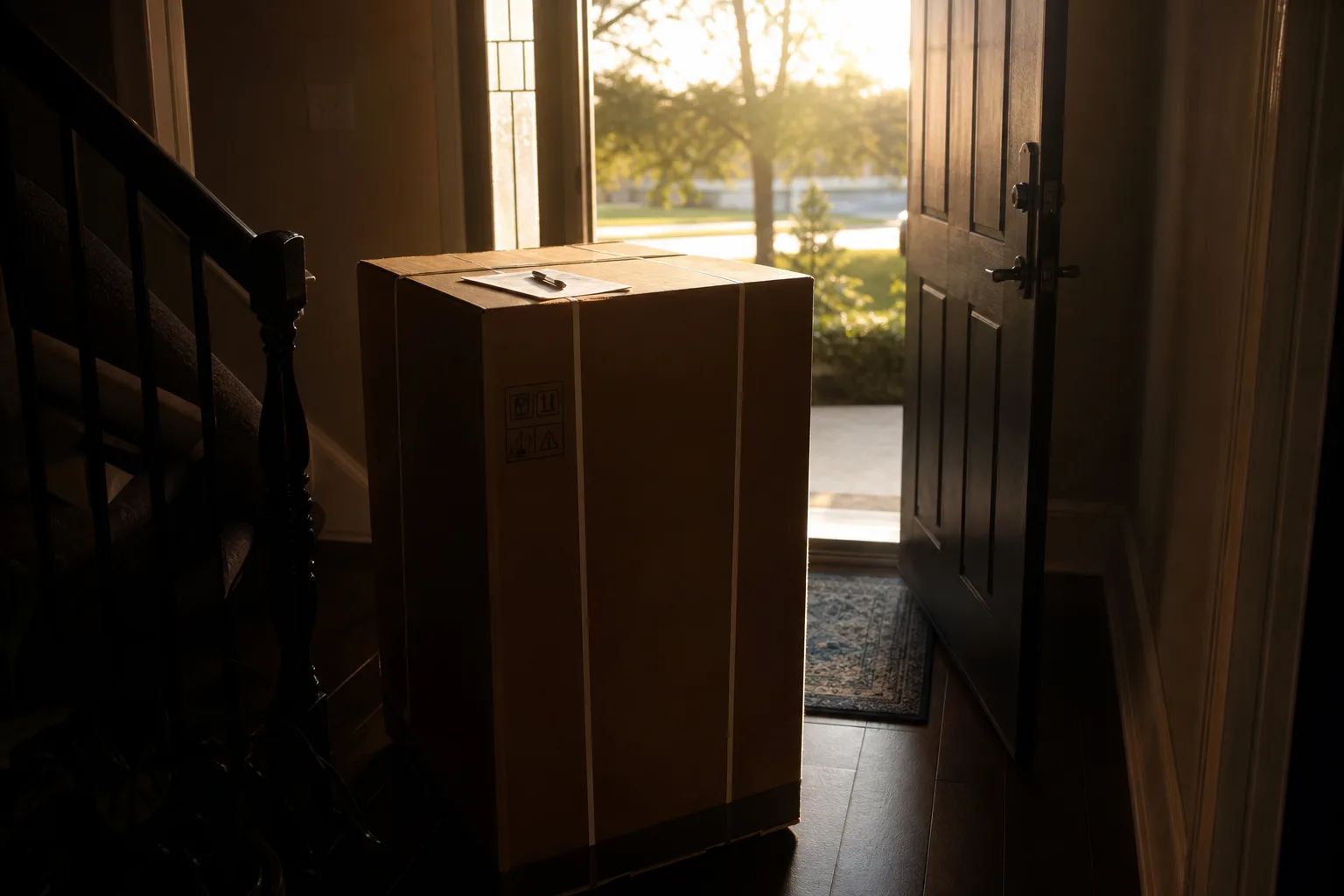
The line on a delivery receipt that reads received in apparent good order is doing more work than almost anyone signing it understands. It is not a receipt for a purchase. It is a statement about the condition of goods at the moment they changed hands, and in a dispute months later it is often the only contemporaneous record either side has. Marisol Devane has spent twenty-two years on the claims side of a national furniture and appliance delivery network, first investigating them and now supervising the people who do. She agreed to walk through what that signature settles, what it leaves open, and what a customer who cannot lift a carton should ask for before the truck is loaded.
What the signature at the door actually settles
When someone signs at the door, what have they agreed to?
They have agreed that nothing was visibly wrong with the outside of the packaging, and that is genuinely all, though people read it as a full release. A crushed corner, a puncture, a carton that has clearly been rewrapped in a warehouse: those are visible, and if they are not noted at the time, the claim gets harder. What is inside the box is a separate question with a separate window. The trouble is that the two get collapsed in people's minds, so someone signs, discovers a cracked panel four days later, and assumes the signature closed the door.
The standard advice is to open and inspect before the driver leaves. Who can actually do that?
Not the customer we most need to protect. A sixty-pound carton on a hand truck in a hallway is not something a person with a bad back, a cane, or one working arm is going to open, unpack and reassemble while a driver stands there with four more stops. Older customers tell me they felt rushed, and they were right, because the route is built to a clock. So the honest answer is that the inspect-at-the-door rule was written for a warehouse dock, not a doorway, and the fix is to write on the receipt that the carton was accepted unopened and subject to inspection. Drivers are trained to allow that notation, and a legible note beats a rushed unboxing every time.
The clock on damage you cannot see yet
How long does someone actually have?
Concealed damage windows are short and they are stated in the terms nobody reads at checkout. Some run a few days from delivery, some run longer, and interstate household goods moves sit under a different framework again, since the Federal Motor Carrier Safety Administration is responsible for how those movers handle valuation and the claims process. The number matters less than the fact that the clock starts at delivery, not at the moment the customer finally gets help to open the box. If you know your son visits on Sundays and the delivery is on a Tuesday, that is five days of the window spent before anyone has looked.
What can be done about that gap?
Ask for the delivery date to be set near the day you will have help, and ask in writing. On a larger network that is a scheduling request rather than a favor, because the appointment system already handles building access, elevator reservations and certificate-of-insurance requirements for condominiums. The other move is to photograph the carton before it is opened and again as it comes apart, with the shipping label in frame. Adjusters accept that sequence readily. It converts a slow unboxing from a liability into documentation, and it costs the customer nothing but two minutes of a phone camera.
Two ways a box gets packed, and which one the claim follows
Does it matter who packed it?
It decides most claims. A carton packed and sealed at a factory or by the carrier's own crew carries a presumption that the packing was adequate, so if the contents arrive broken, the question is what happened in transit and the loss generally sits with the party who moved it. A carton the customer packed shifts the argument, because the first thing an investigator asks is whether the packing was sufficient for the trip. That is why moving companies price a packing service separately and why they are willing to do it: a professionally packed carton is a carton the mover can be held to.
So paying for packing buys more than labor.
It buys a cleaner claim, and for a customer who cannot kneel on a floor wrapping dishes it buys the only realistic version of the task. I tell people to think of the packing line on the estimate as part of the coverage, not part of the labor. The same logic applies to declared value. The default protection on many shipments is calculated by weight, which is a poor match for a light, expensive item, and the higher valuation option is inexpensive relative to what it protects. Choosing it at booking is a two-minute decision that changes the size of the check.
What the size of the provider changes
Is a large operator better or worse for a customer who cannot lift?
Better, in the specific ways that matter here, because scale is what makes the services exist at all. A two-truck outfit will do you a kindness. A national network has a product code for it: room of choice, unpack and debris removal, appliance haul-away, assembly, stair charges disclosed at booking rather than negotiated on the landing. Those are billable line items, which sounds worse and is actually the point, since a billed service has a defined standard and a paper trail, while a favor has neither. When a favor goes wrong, nobody knows who owes what.
And when something does go wrong?
A larger provider carries the loss in a way a small one often cannot. There is a claims department with a file number, a vendor relationship with the manufacturer, replacement stock in a regional warehouse and, in most cases, a standing arrangement to send a technician rather than a truck. That means a damaged panel becomes a service visit instead of a return shipment the customer has to repack, carry and hand off. For someone who cannot manage a carton alone, the difference between a repair at home and a return to a drop-off point is the difference between resolved and stuck.
Devane's closing advice was narrow and practical: name the constraint out loud when the order is placed, because every accommodation in this business is attached to a service code, and a code has to be entered before the truck is loaded. The customers who fare best are not the ones who argue afterward. They are the ones who said, before anything shipped, that nobody at this address can lift the box.
Further reading
- . Can't Stand at the Curb to Inspect a Pallet? The Delivery Receipt Decides Who Pays.
- . Can't Lift a Pallet Anymore? Who Actually Handles Your Stock Once a Third Party Stores It.
- . Signing With a Bigger 3PL? Where the Extras Hide in a Fulfillment Quote.
- . Hiring an Outside Specialist? Five Checks That Separate Good From Merely Plausible.