Can't Lift a Pallet Anymore? Who Actually Handles Your Stock Once a Third Party Stores It
Abstract. Outsourcing storage replaces your own lifting with other people's labor, and the contract decides who pays when a pallet is dropped, miscounted, or lost.
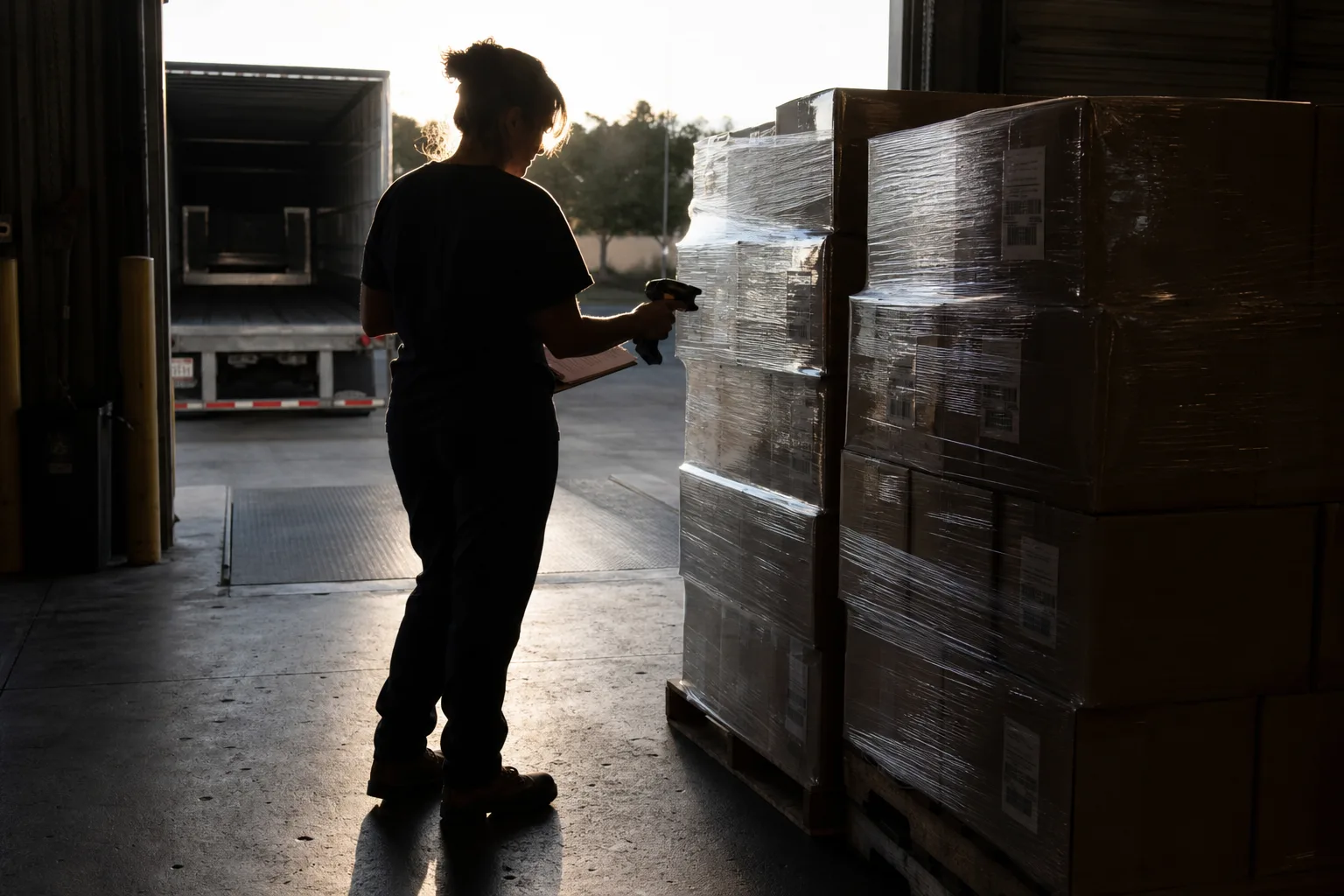
Handing inventory to a third-party warehouse is usually presented as arithmetic: the square footage you would rent against the per-pallet and per-pick fees somebody else charges. That comparison misses the part that actually determines whether the arrangement works, which is that the physical work does not disappear when you stop doing it. It moves to a receiving clerk, a forklift operator, a picker walking a route a software system drew, and a returns associate opening a box somebody shipped back. Their working conditions, their turnover, and the contract that limits what their employer owes you are the real variables.
The four people between the truck and the doorstep
A pallet arriving at a contracted warehouse passes through a small, identifiable set of hands. A receiving clerk counts it against the advance ship notice you sent, and whatever discrepancy gets recorded there becomes the baseline for every later argument about missing units. A lift operator moves it to a rack location. A picker, usually working to a rate the building tracks by the hour, pulls units into a tote. A packer boxes them. At a larger provider each of those roles is separated, measured, and staffed from a pool, which means consistency improves and the person who touched your order on Tuesday is unlikely to be the one who touches it Thursday.
That separation is why the receiving step deserves more of your attention than the shipping step. Everything downstream inherits the count made at the dock by someone with a scanner and a limited window. Sellers who send clean pallets, labeled at the carton level, with quantities that match the paperwork exactly, get clean counts. Sellers who send mixed cartons with handwritten quantities get a discrepancy report and a bill for sorting time. The labor you avoid by outsourcing is real, but the preparation you still owe is specific and worth doing well.
The liability cap is the clause that decides the loss
Most warehousing agreements do not make the provider an insurer of your goods. They limit liability to a figure tied to weight, to the value declared on the warehouse receipt, or to some multiple of the monthly storage charge for the affected lot, and they exclude consequential damages entirely. Read in isolation that looks unfair. Read against the premium, it is the reason storage costs what it costs. The provider is selling handling and space, not coverage, and the gap is meant to be filled by your own policy on inventory held off premises.
So the question to put to a broker before you sign is narrow and answerable. Does your commercial policy extend to stock at a named third-party location, at what limit, and does it respond to the specific causes of loss a warehouse produces: forklift damage, sprinkler discharge, mysterious disappearance, and damage discovered only when a customer opens the box. Mysterious disappearance is the one that surprises people, because it is the shrinkage category a warehouse will not pay for and a thin policy will not either. Confirming that one line in advance converts a vague worry into a priced, covered risk.
What scale buys, and what it asks of the worker
A larger provider runs standardized processes because standardization is what makes a shared building profitable, and the same standardization is what makes your account predictable. Rack heights are uniform. Pick paths are generated rather than remembered. Cycle counts happen on a schedule instead of when someone notices a gap. The trade is flexibility: unusual packaging, hand-assembled kits, and products that do not fit a standard carton either get quoted as special projects or get declined. Knowing which category your product falls into before implementation is cheaper than discovering it in week three.
Scale also changes who bears the physical risk. The Occupational Safety and Health Administration oversees workplace safety in warehousing, and the rules governing powered industrial trucks, lifting, and emergency egress apply to the building your goods sit in. Bigger operators tend to invest in the equipment that keeps those obligations met: conveyors, pallet jacks with powered lift, adjustable packing stations, and training programs that carry across shifts. That investment is not charity. It reduces injury claims and turnover, and the stability it produces shows up in your fill rate.
The seller who cannot lift, and why this is an access decision
For a meaningful number of small sellers the move to contracted fulfillment is not a growth decision at all. It is what happens when a back gives out, when a wheelchair makes a self-storage unit with a roll-up door and a gravel approach unusable, or when standing at a counter printing labels for three hours stops being possible. Self-storage asks you to drive there, lift, reach, and wait for an elevator that may or may not be working. A fulfillment contract asks you to send clean data and good pallets. The second set of demands can be met from a seated position, in your own time, which is the whole point.
Evaluate providers on that basis and different questions become urgent. Can you get inventory counts and order status without a phone call, because a portal does not require you to hold a handset or stay on hold. Will the provider accept small, frequent replenishments rather than full truckloads, since a full truckload assumes you can stage and load one. Is there a named account contact who answers email, and does the returns process run without you receiving, inspecting, or rebagging anything yourself. Providers built for volume usually answer yes to all four, because those are the same features a large client demands.
The arrangement works when the division of labor is written down: your count against their count, your coverage against their cap, your packaging standard against their intake rules. Settle those four pairings before the first pallet ships and the rest of the relationship is mostly invoices.
Further reading
- . Can't Stand at the Curb to Inspect a Pallet? The Delivery Receipt Decides Who Pays.
- . Signing With a Bigger 3PL? Where the Extras Hide in a Fulfillment Quote.
- . Hiring an Outside Specialist? Five Checks That Separate Good From Merely Plausible.
- . Hiring Your First Outside Expert in Busy Season? What the Calendar Adds to the Bill.