Can't Stand at the Curb to Inspect a Pallet? The Delivery Receipt Decides Who Pays
Abstract. Carrier liability turns on packing, valuation and what you write on the delivery receipt, and the rules shift once a shipment stays inside one state.
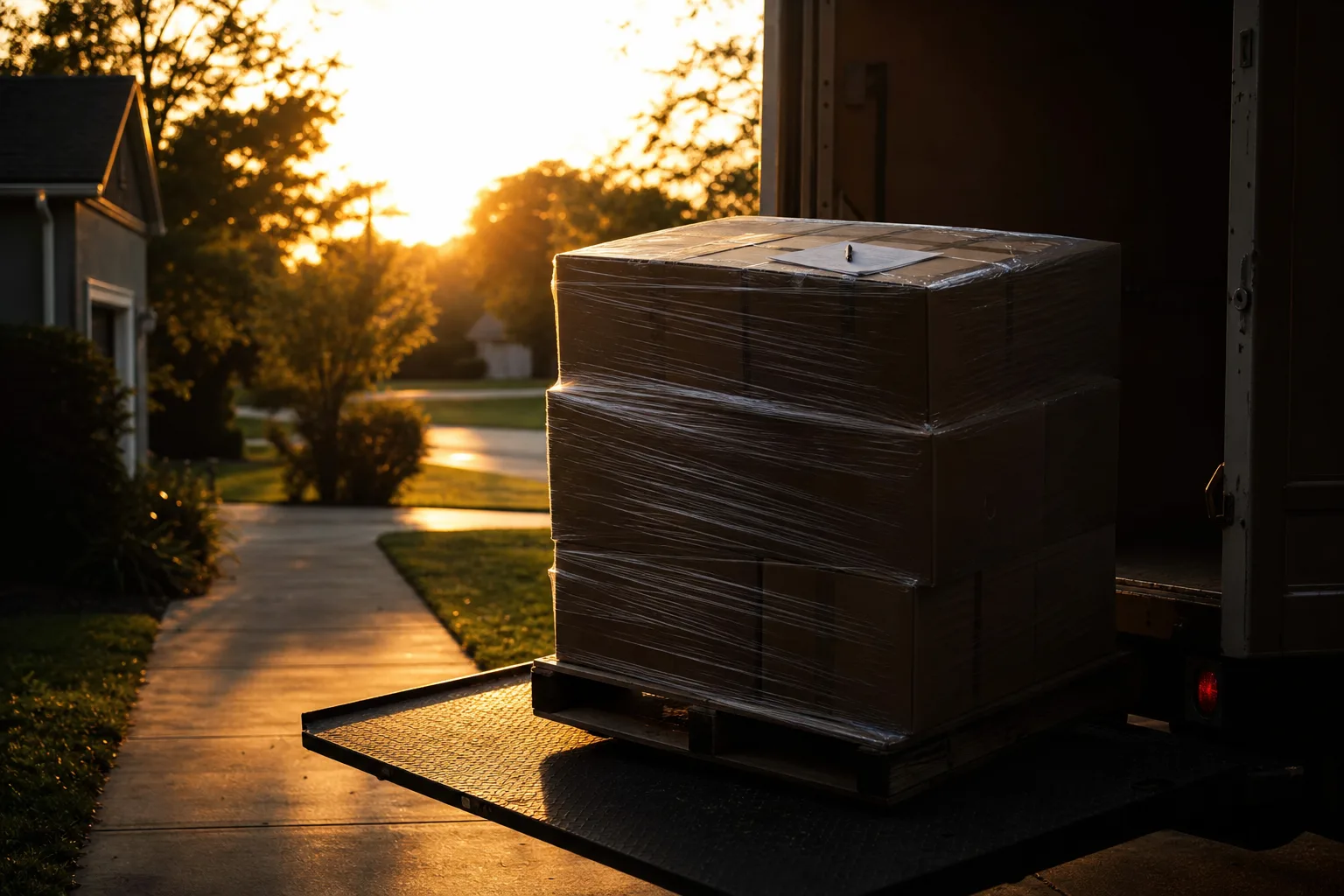
The moment that decides most freight damage claims lasts about ninety seconds and happens on a driveway. A driver rolls a pallet down a liftgate, holds out a tablet or a paper delivery receipt, and waits. Whatever gets written in that box, or left blank, becomes the carrier's version of the condition of the goods at delivery. For a person who cannot crouch to check a bottom carton, cannot lift a corner to look underneath, or cannot keep a driver standing for twenty minutes without feeling rushed, that ninety seconds is where the money quietly moves from one side to the other.
What the signature actually transfers
A clean delivery receipt is treated as evidence that the shipment arrived in good order, which shifts the burden onto you to prove the damage happened in transit rather than afterward. Noting exceptions reverses that. The useful habit is narrow and specific language written before signing: crushed corner on carton three, shrink wrap torn on two sides, pallet leaning, carton opened and retaped. Photographs taken while the freight is still on the truck or still on the liftgate are worth more than photographs taken in a garage an hour later, because the first set places the damage with the carrier.
Most carriers also allow a concealed damage report, filed within a short window after delivery, for harm that could not be seen through packaging. Those windows are tight, often measured in days, and they are published in the carrier's tariff rather than announced at the door. Finding that window before the shipment moves, not after the box is open, is one of the cheapest pieces of preparation available. If you cannot inspect at the curb for physical reasons, write that on the receipt too: subject to inspection, consignee unable to inspect at delivery.
Valuation is a number you choose, not a value you have
Carrier liability for most freight is not the worth of the contents. It is a released rate, usually a few dollars per pound per article, printed in the tariff and applied without regard to what you paid. A sixty pound cabinet destroyed in transit pays out as sixty pounds of cabinet. Full value protection, declared value, or separate shippers interest cargo insurance buys a different arithmetic, and each carries a premium and a deductible that are worth comparing against the real replacement cost of the one or two items in the load you could not easily replace.
The judgment to build here is about concentration rather than totals. A pallet of evenly priced goods rarely justifies extra coverage, because the released rate and the loss track each other reasonably well. A shipment carrying one power wheelchair, one adjustable bed, one custom ramp section, or one piece of medical equipment with a long lead time is the opposite case: the per pound formula will pay a fraction, and the replacement interval is the real cost. The question is not what the load is worth but what a six week wait for one item would do to a household.
Who packed it decides who is believed
Carriers distinguish sharply between cartons they packed and cartons the shipper packed, and the distinction appears on paperwork as a notation that the goods were packed by owner. Where the shipper packed, the carrier will argue insufficient packaging first and handling second, and that argument is often enough to reduce or deny a claim. Double wall cartons, corner protection, void fill that does not settle, and a pallet that is stretch wrapped to the deck rather than to itself are the specifics that keep the conversation on handling. Carrier packing costs more and moves the argument.
The rules change at the state line, and again at the building door
Interstate motor carriage runs on federal ground, where the Federal Motor Carrier Safety Administration oversees household goods movers and carriers must give written estimates and disclose valuation options. A shipment that starts and ends inside one state is a different animal: intrastate moves are regulated by state agencies, commonly a public utilities commission, a department of transportation, or a state licensing board, and the liability minimums, the claim filing windows, the licensing requirements and the complaint route all vary accordingly. Checking which regime applies before booking tells you which rulebook your claim will be read against.
Local rules then narrow things further. Many condominium and apartment buildings require a certificate of insurance naming the association, restrict moving hours, require an elevator reservation, and limit how long a truck may occupy a loading zone. Dense cities add street permits for curb space. These are the provisions that decide whether a delivery stops at the threshold or reaches the room, and threshold delivery is the default on most freight tariffs. Inside delivery, room of choice, liftgate service, debris removal and unpacking are priced separately and must be ordered on the bill of lading in advance.
Ordering those services in writing does two things at once. It gets the goods to a place where someone who cannot lift can actually use them, and it extends the carrier's custody far enough that damage in the hallway is still the carrier's damage. The accessible choice and the protected choice turn out to be the same line item.
Further reading
- . Can't Lift a Pallet Anymore? Who Actually Handles Your Stock Once a Third Party Stores It.
- . Signing With a Bigger 3PL? Where the Extras Hide in a Fulfillment Quote.
- . Hiring an Outside Specialist? Five Checks That Separate Good From Merely Plausible.
- . Hiring Your First Outside Expert in Busy Season? What the Calendar Adds to the Bill.