First Commercial Policy? How the Coinsurance Clause Decides What a Partial Loss Pays
Abstract. Under-insure a building and the averaging clause cuts every partial loss by the same fraction. Here is who is qualified to set the value, and how to check.
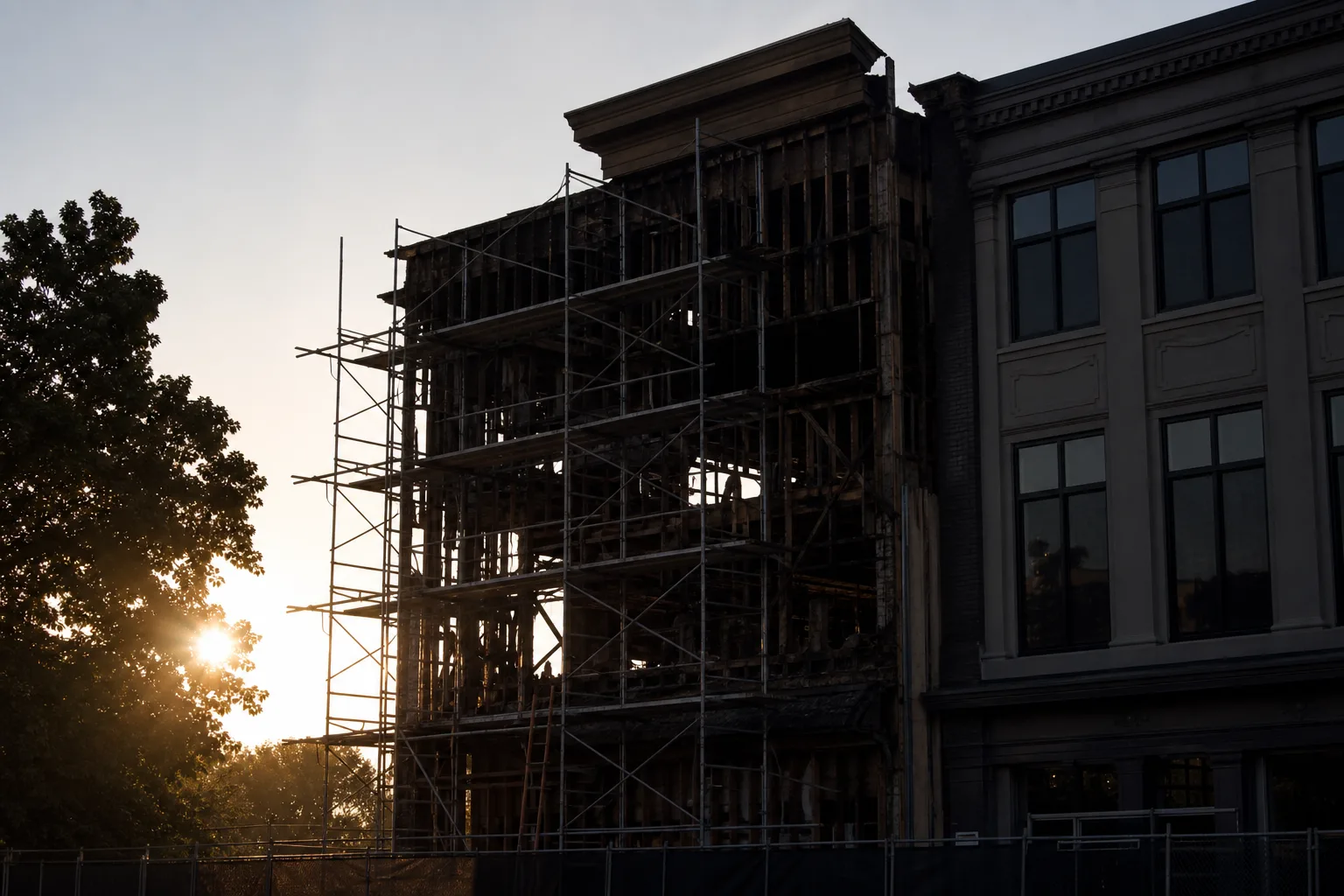
The penalty for carrying too little property insurance almost never arrives as a refused claim. It arrives as a check that is short by a consistent, calculable fraction, and the fraction was fixed on the day the policy was written rather than the day the roof came off. Anyone buying a commercial property policy, a landlord package or a homeowners form with a replacement cost provision has agreed to a valuation rule they probably did not read. The rule does its work quietly for years. It only speaks up once, during adjustment, and by then the number cannot be changed.
What the averaging clause actually does to a partial loss
A coinsurance clause, which the trade also calls averaging, requires you to carry a limit equal to a stated percentage of the property's insurable value, commonly eighty, ninety or one hundred percent. If your limit falls below that requirement, the insurer pays the loss multiplied by the ratio of what you carried to what you should have carried. Take an illustration with round figures: a building with a one million dollar replacement cost, an eighty percent clause, and a six hundred thousand dollar limit. The requirement is eight hundred thousand, the ratio is three quarters, and a two hundred thousand dollar fire loss becomes a one hundred fifty thousand dollar payment before the deductible comes off.
Notice what that arithmetic does not depend on. It does not depend on bad faith, on a missed premium, on how the fire started, or on whether anyone told you the building had appreciated. The shortfall is mechanical. It also bites hardest on exactly the losses most owners actually have, the partial ones, because a total loss is capped by the limit anyway and at least pays the full amount you bought. Under-insurance is therefore not a problem of the catastrophic event. It is a problem of the ordinary event, and it recurs at every renewal until someone fixes the value.
Who is qualified to set the number, and how to confirm it
First-time buyers usually get their insurable value from whoever is closest to hand: a purchase price, a bank appraisal, a property tax assessment, or a figure the agent typed into a cost estimator during a fifteen minute call. None of those measures replacement cost. A purchase price includes land and reflects a market; a tax assessment reflects a county formula; a lender's appraisal answers a lending question. Replacement cost is a construction question, and the people licensed to answer construction questions are appraisers, cost estimators and contractors, not the person selling you the policy.
Credentials here are checkable, and checking them takes minutes. Real estate appraisers are licensed or certified by a state appraiser board, and every state maintains a searchable roster showing license type, status and disciplinary history; the professional designations layered on top, MAI and SRA from the Appraisal Institute among them, are held in registries you can query by name. Your agent or broker holds a separate state insurance producer license, verifiable through the state department of insurance lookup, and may also hold a voluntary designation such as CPCU or CIC that tests coverage knowledge rather than valuation. Ask which of those two things the person actually has. An agent with a designation is not an appraiser, and an appraiser is not an authority on your policy wording.
What separates a thorough valuation from a barely adequate one
A barely adequate job produces a single number with no visible inputs. Someone enters a square footage, a construction class and a zip code into a cost estimating service, prints the total, and the limit follows the total. It is not fraudulent and it is not useless, but it carries no evidence of the building you own, and it tends to drift low because default assumptions are generic. When an adjuster later reconstructs the insurable value from the actual structure, the gap between the generic estimate and the specific building becomes the averaging fraction, and you fund the difference.
A good job is recognizable by what it names. It identifies the construction class, the wall and roof assemblies, the mechanical systems, the finish level in each area, and the ceiling heights. It separates the items your policy does not cover, footings and underground piping in many forms, from the items it does. It adds the costs that show up only after a loss: debris removal, permits, design fees, and the price of complying with current building code when a partially damaged structure must be brought up to standard, which is its own coverage rather than part of the base limit. It states the effective date, and it says what would make it stale.
The endorsements that move the penalty off you
Once the value is credible, you can buy your way out of the averaging mechanism, and this is where a competent broker earns the commission. Agreed value, sometimes written as a waiver of coinsurance, suspends the clause for the policy term in exchange for a signed statement of values, so a partial loss pays without the ratio. A blanket limit spreads one limit across several buildings, though many blanket forms reintroduce a per-location cap through a margin clause, which is worth reading closely. On the homeowners side, extended or guaranteed replacement cost adds a cushion above the dwelling limit, and an inflation guard endorsement raises the limit annually so the figure does not sit frozen while construction costs move.
The renewal discipline matters as much as the endorsement. A statement of values supporting agreed value has to be updated, because the insurer's obligation is tied to the schedule you submitted, and an addition, a renovation or four years of cost escalation can leave the schedule describing a building that no longer exists. Flood is a separate purchase with separate limits, administered through the program the Federal Emergency Management Agency is responsible for, and its caps sit well below the replacement cost of many commercial structures, which is what excess flood coverage exists to close. Diary the valuation review the same way you diary the premium.
The useful test for a first-time buyer is simple to apply and hard to fake. Ask the person quoting the policy what percentage coinsurance requirement appears in the form, where the insurable value came from, and who holds the credential behind it. An answer with three specifics in it means someone did the work. A single round number, offered without a source, is the beginning of the conversation rather than the end of it.
Further reading
- . Filing a Claim Without Hurting Next Year's Renewal? Compare the Four Routes First.
- . First Claim on the Policy? Three Routes to the Same Repair, and What Each Puts on Your Record.
- . Your Rebuild Cost Moved and Your Limit Didn't. How the Percentage Clause Cuts Your Check.
- . Backordered Siding, a Long Repair, and the Exclusion That Decides Who Pays for the Wait.