Backordered Siding, a Long Repair, and the Exclusion That Decides Who Pays for the Wait
Abstract. A restoration estimator explains why homeowners policies exclude delay and mismatched materials, and how a household keeps a supply holdup from becoming its own loss.
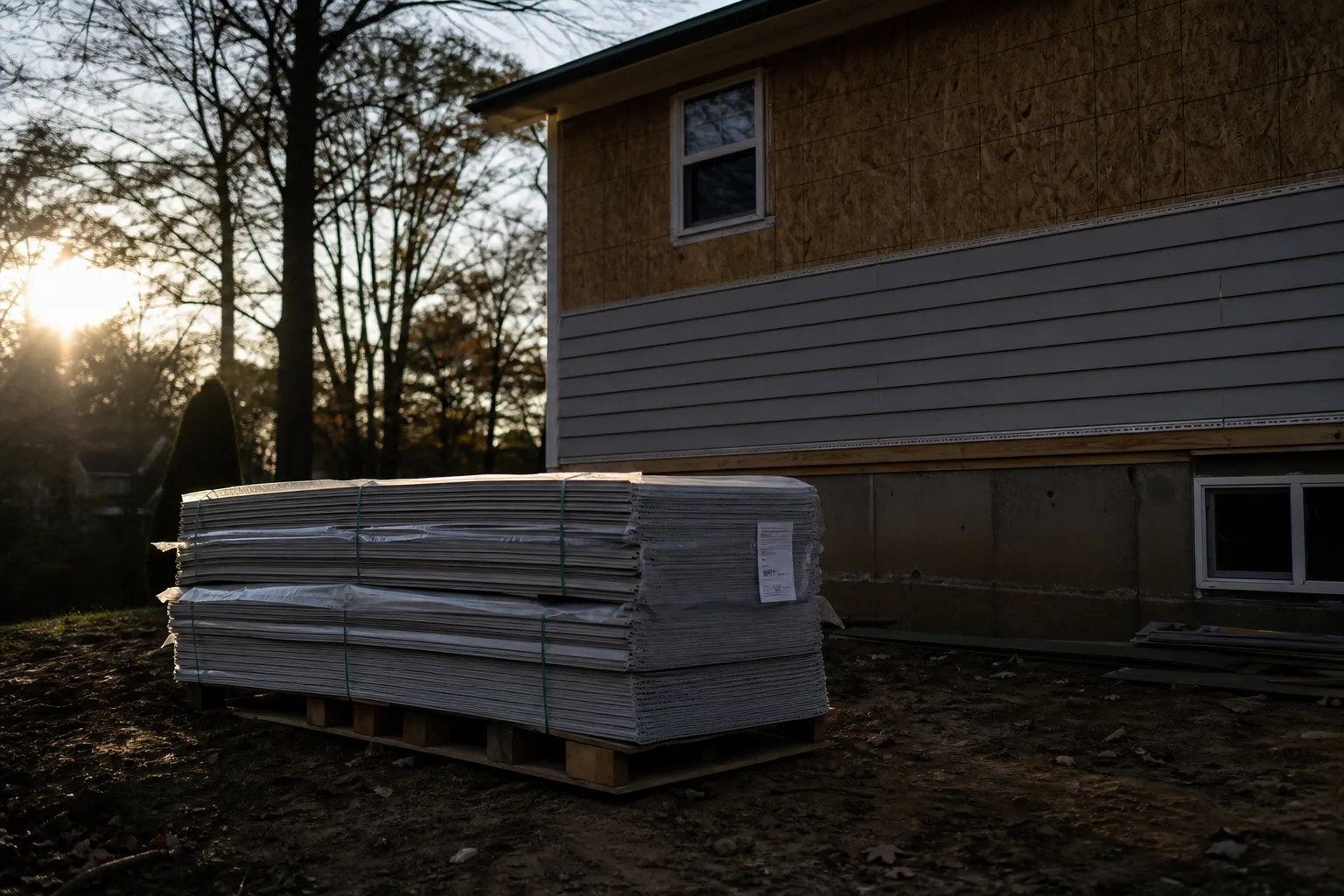
The exclusion pages in a homeowners policy are not there to be cruel. They are there because an insurer priced a specific set of risks and had to draw a line around everything else, and the line usually lands on things nobody can forecast: how long a part takes to arrive, whether the discontinued profile can be matched, what the building department demands once the wall is open. I asked a restoration estimator who prices repairs for carriers and homeowners in the Great Lakes region, and who spoke on the condition that we identify him by role rather than name, to walk through the clauses that come up once a job stalls on supply.
Why the clause is on the page in the first place
His answer starts with pricing rather than with law. An insurer can model the frequency of a burst supply line, a wind-lifted shingle, a kitchen fire, because those events have decades of loss history behind them. It cannot model the week a distributor loses an allocation, so it excludes the consequences of delay and prices the rest. That is the trade a household actually buys, he says, and the exclusion is the visible edge of it.
"The clause is doing bookkeeping," he told me. "It says this policy covers the damage, and it does not cover the calendar. Every argument I get pulled into is really a fight about which of those two things a cost belongs to."
The delay exclusion, seen from three weeks downstream
Here is where the supply side and the policy language meet. A hailed roof gets tarped, the adjuster writes the scope, and then the specified panel or shingle goes on allocation for two months. The house is dry, so nothing is accruing, and the exclusion for delay never gets tested. Change one variable, though, and the picture changes with it: if the temporary protection fails during the wait, the carrier will ask whether the new damage came from the original covered event or from the household's failure to protect the property afterward.
That duty to mitigate, he says, is the part homeowners underestimate most. "Nobody reads the wait as their problem until the second storm. Then it matters enormously whether you were replacing the tarp, calling the supplier, keeping the emails." His practical rule is that a documented wait behaves very differently from an undocumented one, because a paper trail converts the delay into someone else's chain of custody. He keeps dated supplier confirmations in the claim file for exactly that reason.
Matching materials, and the substitution nobody signed off on
The second clause worth reading closely limits the carrier's obligation to match undamaged materials. Siding from a discontinued run, a tile glaze that shifted between production lots, a hardwood width no mill still cuts: the policy generally pays to repair the damaged area, not to replace three sound walls so the fourth blends. Households read that as a technicality until the substitution shows up on the elevation facing the street.
His counsel is to force the substitution decision into writing before the crew opens the box. If a contractor proposes an alternate profile because the specified one has a long lead time, the household should ask three questions and get answers on paper: whether the carrier has agreed to the substitute in the scope, whether the alternate carries the same manufacturer warranty term, and who owns the appearance result if the blend fails. All three sit with somebody. Silence assigns them to the homeowner.
He has watched that go the other way often enough to be encouraging about it. Where the household raised the matching question early, carriers frequently approved a wider replacement area rather than argue about an obvious seam, and the file closed faster than the backorder would have allowed.
What a household can actually change
Some exclusions can be bought back. Ordinance or law coverage handles the code upgrade a repair triggers, and it is usually a small endorsement rather than a separate policy. Loss of use pays for the rental during a displacement, and its limit, often expressed as a period or a percentage, is worth knowing before a long lead time turns a four-week absence into eleven. Flood sits outside the standard homeowners form entirely, which is why the Federal Emergency Management Agency administers the national program that covers it. Reading those three items against the way your house is actually built is the whole exercise.
The estimator's last point was about sequence. A household that identifies the long-lead components in its own house, the stone, the custom glass, the discontinued cabinet line, and asks its agent how the policy treats each one, is doing the underwriting work in advance rather than during a claim. That conversation costs an hour.
The clauses are not hidden and they are not arbitrary. They mark the boundary between a loss the insurer agreed to carry and a schedule nobody controls, and a household that knows where that boundary runs can keep a supply holdup from turning into a second claim.
Further reading
- . Filing a Claim Without Hurting Next Year's Renewal? Compare the Four Routes First.
- . First Commercial Policy? How the Coinsurance Clause Decides What a Partial Loss Pays.
- . First Claim on the Policy? Three Routes to the Same Repair, and What Each Puts on Your Record.
- . Your Rebuild Cost Moved and Your Limit Didn't. How the Percentage Clause Cuts Your Check.