Reading a Hospital Bill Line by Line, and the Two Names You Should Verify First
Abstract. A decade ago an itemized hospital bill had to be pried loose; now the price file, the estimate and the provider registry are all public, and they can be checked against each other.
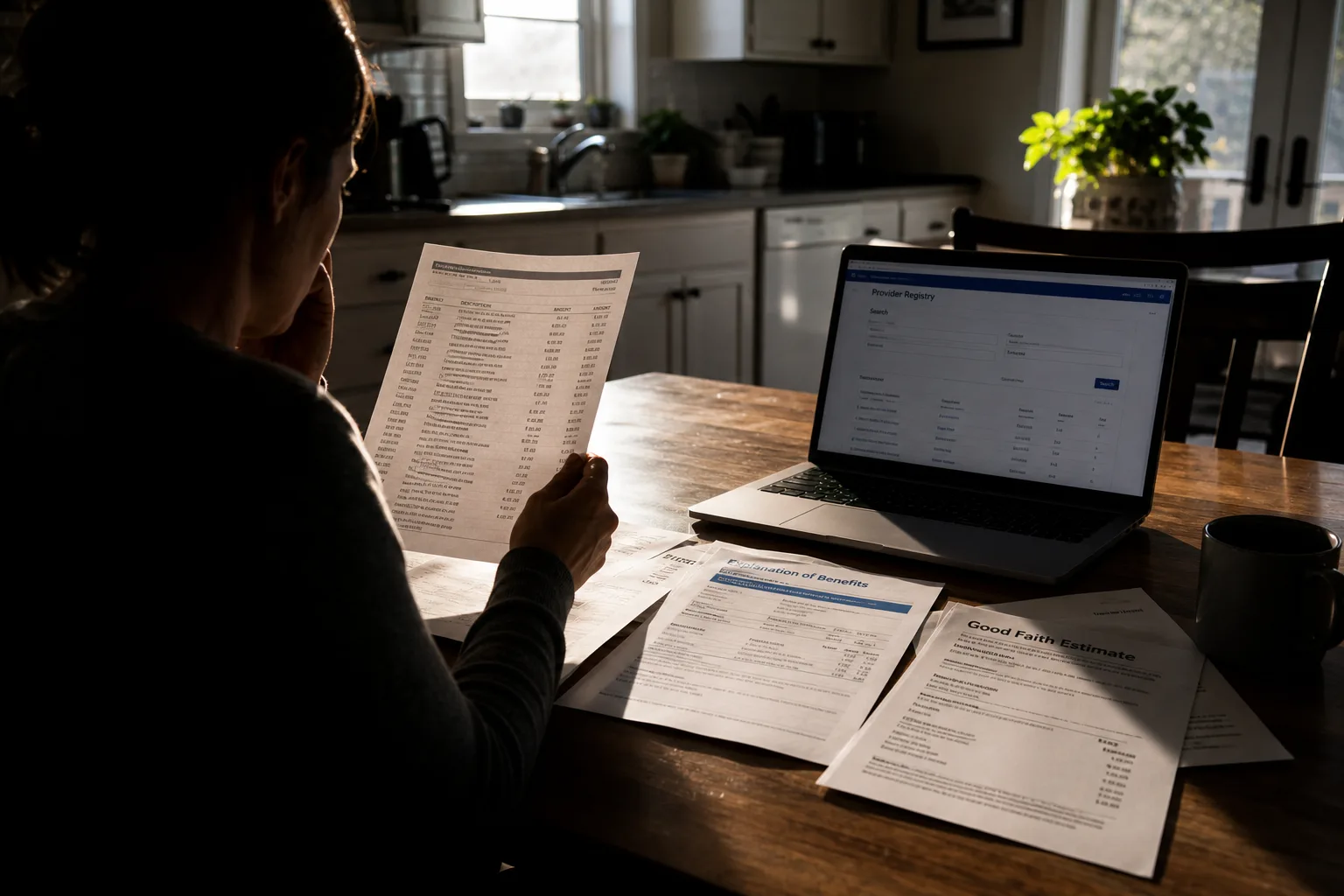
The bill that arrives after an outpatient procedure is not one document. It is a summary of several ledgers, kept by entities that may not share a parking lot, a tax ID, or a phone system, and the paper you hold is usually the least detailed version of any of them. Ten years ago that was the end of the trail unless you wrote and asked for more. Now the fuller record exists in three or four places at once, and most of it is public. The work is comparing them.
The itemized statement stopped being a favor
A decade ago, the first statement you received was a summary: a department, a date, a balance. Getting the line-level version meant calling patient accounts, asking specifically for an itemized statement with procedure codes, and waiting for it to be mailed. Some systems treated the request as unusual. The change since then is not that hospitals became forthcoming; it is that federal price transparency rules put standard charges into published files, and the No Surprises Act put written estimates into the hands of patients who are uninsured or paying cash. The Centers for Medicare and Medicaid Services oversees both requirements.
That matters for a practical reason. You now have something to read the bill against. A good faith estimate lists the codes a provider expected to bill and what each was expected to cost. The posted price file lists the charge the facility says it applies to those codes, including its negotiated rates by plan. When the statement in your hand disagrees with either, you are no longer arguing from instinct. You are pointing at the organization's own published numbers and asking which one governs.
Two names, and neither one is the doctor you met
Every line on a professional claim carries a billing entity and a rendering provider, and those are separate questions. The billing entity is the organization that owns the receivable: a physician group, a hospital corporation, a management company, an anesthesia partnership. The rendering provider is the individual clinician credited with the service. Both are identified by a National Provider Identifier, a ten-digit number that appears on claims and explanations of benefits. The NPI registry is searchable by the public, free, and updated by the enumerating body rather than by marketing departments.
Look up both. The registry tells you the legal name behind a trade name, the practice location on file, and the taxonomy code describing what kind of provider that NPI is enumerated as. It does not tell you whether a state license is current, and it never has. That is a separate check, at the state medical, nursing, or dental board, where you can confirm the license number, its status, its expiration, and any public discipline. Two lookups, ten minutes, and the names on the bill stop being abstractions.
What the acquisition did to your bill
The single biggest change in the last ten years is ownership. A great many independent practices are now departments of health systems, and the billing consequence is provider-based status: the same visit, in the same building, with the same physician, splits into a professional charge and a facility charge. Ten years ago that suite billed one line. Now it bills two, and the second one carries the hospital's rate structure rather than the clinic's. Nothing about the exam room changed. The tax ID on the claim did.
You can usually see the change before the bill arrives. Provider-based departments are required to give notice that the location is part of a hospital and that the patient may owe a facility charge; the letterhead, the practice name, and the entity on the credit card receipt often shift in the same month. On the statement itself, the tell is a revenue code and a facility line for an encounter you would have expected to be professional only. Ask the billing office directly whether the location is provider-based and what the facility component covers. The answer is on file, because the designation is registered.
Reading the lines against each other
Work the itemized statement, the explanation of benefits, and the estimate as three columns describing one event. Match by code, not by description, because plain-language descriptions are written locally and vary. Check that the date of service on each line is a date you were actually there. Check units: two units of an injection you received once is the most common quiet error, and the correction is arithmetic rather than argument. Check that supplies and room time are not billed alongside a bundled procedure code that already includes them.
Where the estimate and the bill diverge materially, the patient-provider dispute resolution process exists for self-pay patients, and insured patients have an internal appeal followed by external review. Both run on deadlines, and the deadlines are printed on the notice that came with the denial. Write the date on the folder. If a prepayment or deposit was taken at check-in, note what it was applied to; deposits collected against an estimate should be credited line by line, and a refund is owed when the final claim comes in lower.
What the file should contain when you close it
Keep the itemized statement with codes, the estimate, every explanation of benefits, the registry printouts for the billing entity and the rendering provider, the license verification page with its date, and a dated note of each call with the name and extension of the person who answered. That folder is what turns a disagreement into a short conversation, because everything in it came from a source the organization cannot dispute.
Ten years ago the same folder would have been thinner and harder to build, assembled by mail over weeks. The records are now open enough that a careful reader can reconstruct a hospital encounter from the outside, and the cost of doing it is an afternoon.
Further reading
- . Booking a Facelift for the Quiet Season? What the Consultation Tells You Before the Deposit.
- . Four Documents, One Clinic Visit. Which One Actually Tells You What You Were Charged For.
- . Quoted a Course of Treatment? Three Ways the Price Is Built, and What Moves It.
- . A Backordered Furnace and a Substituted Model. Which Papers You Keep, and For How Long.