Four Documents, One Clinic Visit. Which One Actually Tells You What You Were Charged For
Abstract. A wheelchair seating evaluation generates at least four pieces of paper, and only one of them lists what happened in the room. Here is how they compare, and which to ask for first.
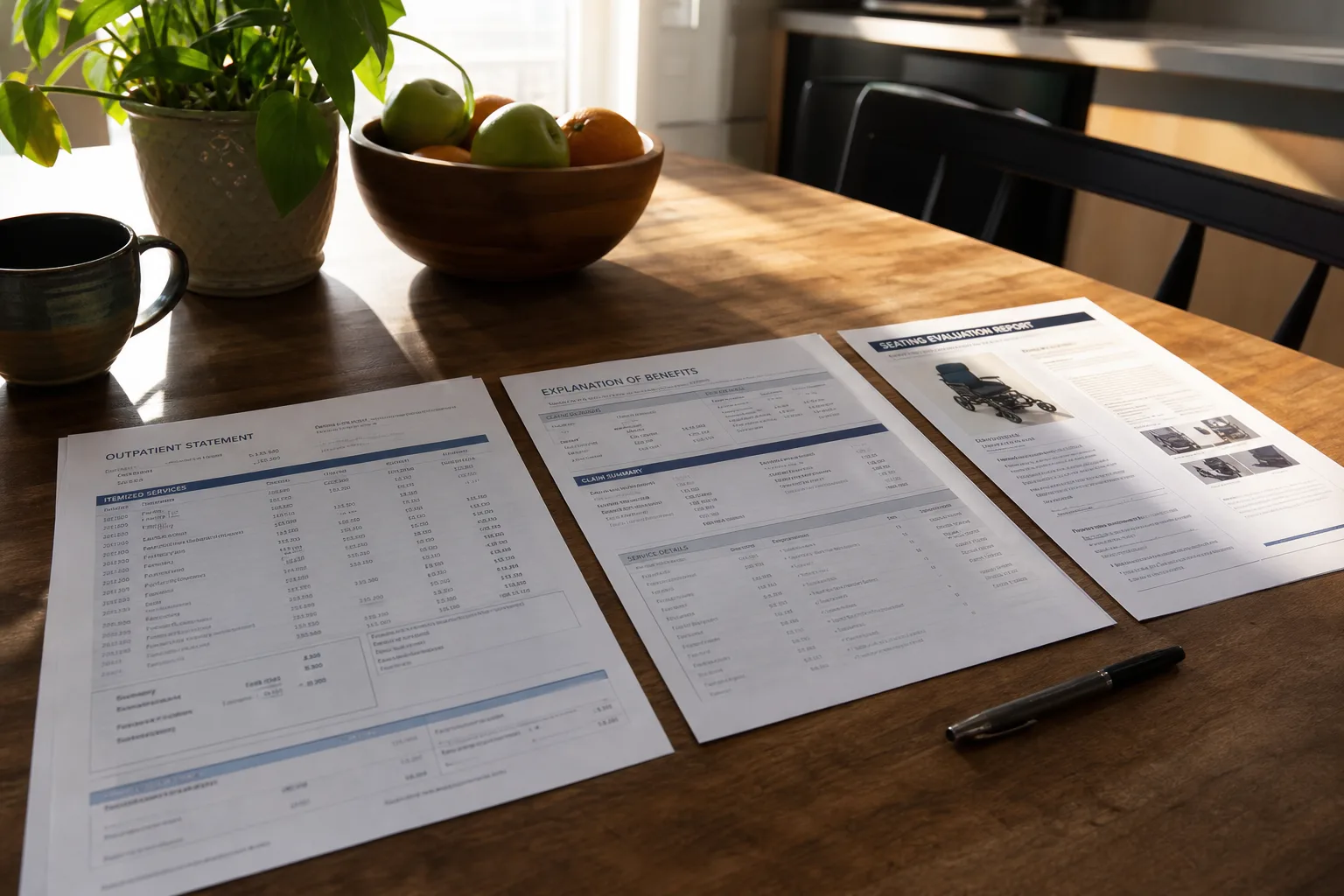
A seating and mobility evaluation is a useful test case for medical billing because it generates more paper than almost any other hour of outpatient care. One appointment, one room, one clinician, and the charges land in at least three separate places: a hospital outpatient department facility fee, a professional fee from the therapist or physician, and a supplier claim for the chair or the cushion that follows weeks later. The patient receives documents from all three, none of which agree on format, vocabulary, or arrival date. Reading them well is a matter of knowing which document answers which question.
The four documents, and the single question each one answers
The summary statement is the one that arrives first and says the least. It carries a total, a payment from insurance, an adjustment, and a balance, usually with a line that reads something like outpatient services or clinic visit. It answers one question: what does this organization believe you owe today. It does not tell you what was done, who did it, how long it took, or what code was submitted. Treating it as the bill is the single most common error, and it is the error that billing departments are structurally comfortable with, because nothing on that page can be disputed line by line.
The itemized bill is the document that lists what happened. Every charge appears as its own line with a revenue code, a procedure code, a date of service, a quantity, and a charge amount. This is the only paper that will show you that a cushion was billed twice, that a sixty minute evaluation was coded as four fifteen minute units when the appointment ran forty minutes, or that a supply item you never saw appears under your name. You have to ask for it. In most systems it is not generated automatically, and the request is routine enough that the phone staff have a script for it.
The explanation of benefits comes from the insurer, not the provider, and it answers a different question: what did the plan decide. It shows the amount billed, the amount the plan allows under its contract, what it paid, and what it assigned to you as deductible, coinsurance, or non-covered. The crucial feature of an EOB is the denial or adjustment reason attached to any line the plan refused. That reason code is the thing you appeal. It is also the thing a summary statement never shows you, which is why a balance can look like your responsibility when it is actually an unresolved claim.
The fourth document is the claim itself, the form the provider transmitted to the insurer. Hospitals submit on one form and individual clinicians and equipment suppliers on another, and both carry diagnosis codes, procedure codes, modifiers, and the identity of the ordering provider. You can ask for a copy. Patients rarely do, and it is the document that resolves arguments about whether a piece of equipment was billed as a purchase or a rental, whether prior authorization was attached, and whether a modifier that changes payment was applied correctly.
What the seating evaluation actually produces
Consider the narrow case. A power chair user is referred for a seating evaluation after a pressure injury. The appointment is at a hospital-affiliated clinic, lasts most of an hour, involves pressure mapping, a transfer onto a mat table with assistance, measurements, and a discussion of cushion options. Two months later a chair and a cushion are delivered by a supplier. By the end of the quarter there are three statements, two EOBs, and a delivery ticket in the house, and the totals on them do not sum to anything recognizable, because the hospital's charge, the plan's allowed amount, and the supplier's claim are three different numbers describing overlapping events.
The lines worth checking in this particular case are specific. Timed therapeutic codes are billed in units, so the unit count should correspond to the time actually spent, and a visit that ran shorter than planned should not carry the planned unit count. Equipment is billed either as a purchase or a monthly rental, and the distinction determines whether you are finished paying or have a recurring obligation. Cushions and backs are separate items from the chair and carry their own codes. The facility fee is a legitimate charge at a hospital outpatient department, but it should appear once, for one date of service.
There is also the question of what was ordered against what was delivered. A seating evaluation produces a written recommendation, and the supplier's claim should match it. When the delivered cushion differs from the recommended one, whether by substitution, backorder, or a supplier's own stocking preference, the claim may still carry the recommended item's code. The delivery ticket, the evaluation report, and the claim line are three records of one object, and comparing them is work that no one else in the chain has any reason to do.
A barely adequate reading against a good one
A barely adequate reading checks the balance against the deductible, concludes that the number looks plausible, and pays. It is not irrational. The time cost of doing more is real, the vocabulary is hostile, and most bills are approximately correct. What it misses is the category of error that is invisible at the summary level: the duplicate, the unit count, the rental that should have been a purchase, the denial that was never appealed and quietly converted into patient responsibility. Those errors do not look like errors from the outside. They look like a slightly larger total than expected.
A good reading is a three-way comparison. You put the itemized bill, the EOB, and the delivery or visit record side by side and walk the dates. Every line on the itemized bill should appear on the EOB with an allowed amount, and every line on the EOB that was reduced or denied should carry a reason you can read. Lines that exist on one document and not the other are the find. So are quantities greater than one on anything that was singular in the room, and dates of service that do not match a day you were in the building.
The second half of a good reading is sequence. Disputes go to the provider's billing office when the issue is what was recorded, and to the insurer when the issue is what was decided, and sending the right question to the wrong office loses weeks. Appeal windows run from the date printed on the notice, and that date is on the EOB rather than on the statement, which is one more reason the statement is the wrong document to be working from. Put the request in writing, keep the date, and ask the billing office to hold collection activity while the account is under review.
Getting the documents without going to the window
The practical obstacle is that the itemized bill and the claim copy are usually described as things you request, and the request path assumes a person who can hold on a phone line, navigate a portal, or appear at a counter on the second floor of a building where the accessible entrance is at the far end. For a patient who cannot stand and wait, who tires on a phone tree, or who uses a screen reader against a portal that serves statements as flat images, the cost of a thorough reading is not the reading. It is the retrieval.
Three routes are worth comparing. The patient portal is fastest when it works and worst when the documents are images rather than text, so it is worth testing once with a known statement before relying on it. A written request by mail or secure message is slower but creates a dated record, which matters if a balance later goes to collections and you need to show the account was in dispute. A phone call to the billing office is the most flexible, and the thing to ask for by name is the itemized statement with revenue and procedure codes for the date of service, sent in an accessible format, with a note on the account recording the request.
You can also name an authorized representative, in writing, to speak to both the provider and the plan on your behalf. The insurer has a form for this and so does most hospital billing. The Centers for Medicare and Medicaid Services oversees the billing rules and price transparency requirements that shape how these charges are presented, and providers that work within those rules generally have a standing process for producing an itemized statement on request. Asking a clinic's financial counselor to walk a bill with you is free, routine, and considerably faster than teaching yourself the coding.
The chair in this example was medically necessary, correctly prescribed, and properly delivered, and none of that prevents a unit count or a rental flag from being wrong on the claim. The documents exist. They are produced as a matter of course, they can be obtained without leaving the house, and the comparison between them takes an afternoon that is worth considerably more per hour than most work you will do that week.
Further reading
- . Booking a Facelift for the Quiet Season? What the Consultation Tells You Before the Deposit.
- . Quoted a Course of Treatment? Three Ways the Price Is Built, and What Moves It.
- . A Backordered Furnace and a Substituted Model. Which Papers You Keep, and For How Long.
- . Checking a Clinician's License? What the Board Actually Verified, and What It Never Did.