Quoted One Flat Fee for Aligners? What the Number Covers and What Reopens It
Abstract. A clear aligner case is priced as a single figure, but refinements, lab lead times and tray remakes decide whether that figure holds to the end of treatment.
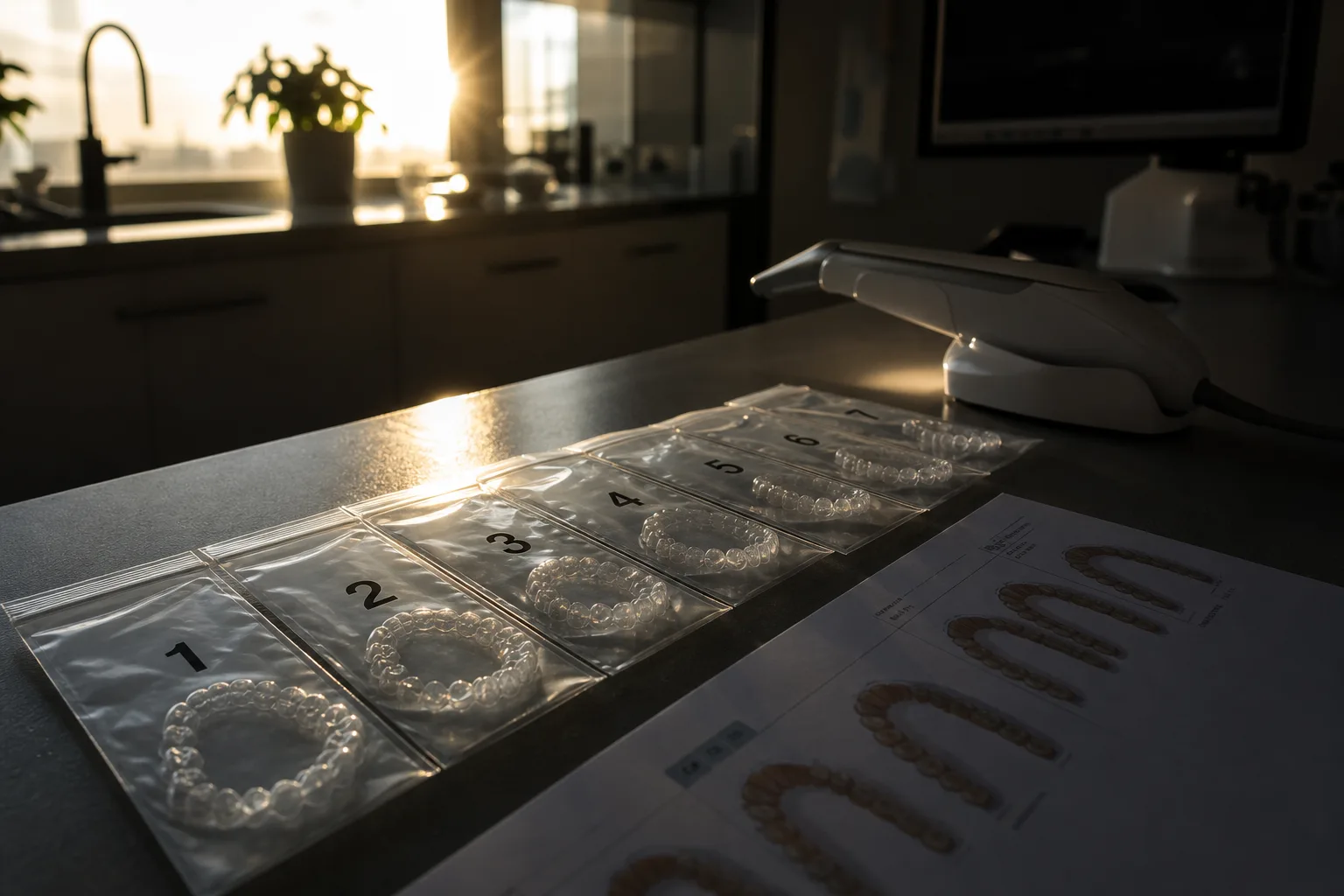
A course of clear aligner treatment is almost always presented as one figure, quoted at the consultation, split into a deposit and a payment plan, and signed before a single tray has been manufactured. The figure is real, but it is a forecast, because the practice is pricing a case it has not yet seen unfold and buying trays from a lab whose production schedule it does not control. Most of the cost variation in these cases is not clinical drama. It is manufacturing volume, turnaround, and who absorbs the remakes.
What the single number is buying
Break a flat aligner fee into its parts and you usually find four: the records and diagnostic work at the start, the lab's fee for the planned series of trays, the practice's chair time across the treatment window, and the retainers at the end. The lab fee is the piece that moves with case complexity, because a plan calling for forty stages costs the practice more than one calling for fourteen. That is why a mild crowding case and a case with rotations and bite correction are quoted so far apart, even in the same chair.
The practice fee behind the trays is a bet on visit count. A quote assumes a certain number of check appointments over the treatment window, and the practice has priced its time accordingly. Ask how many visits the number assumes and what happens on visit thirteen if the plan called for ten. Some practices absorb the overage as the cost of doing business, some bill it, and both approaches are defensible. What matters is that the answer exists in writing before the deposit clears.
Refinements are where two identical quotes stop being identical
Teeth do not always track the plan, and when they stop tracking, the case gets rescanned and a new series of trays is ordered. That second series is a refinement, and it is a second lab order at real cost. Contracts handle refinements in three ways: unlimited within a stated period, a fixed number included, or each one billed. Two quotes a few hundred dollars apart can sit on opposite sides of that clause, and the cheaper one becomes the expensive one the moment a case needs two rounds.
Pin down the time limit as much as the count. Unlimited refinements within eighteen months of the start date is a different product from unlimited refinements until the case finishes, particularly for a patient who misses appointments or wears trays inconsistently. Retainers deserve the same reading, since the first set is often included and replacements rarely are. The Food and Drug Administration regulates aligners and retainers as medical devices, which is part of why replacements run through the practice rather than being reordered casually.
Lead time upstream turns into cost downstream
A scan submitted on a Monday does not become trays on a Monday. There is a treatment plan to approve, a print and thermoform run to schedule, and shipping, and the gap between submission and delivery is where a case quietly gets more expensive. A three week lab turnaround on a refinement means the patient wears the last tray longer, comes in for an interim check that nobody priced, and the treatment window stretches past the refinement deadline written into the contract. The clinical outcome is unchanged. The commercial one is not.
Resin supply, printer downtime and staffing at the lab all show up the same way at the chair, as a date that slips. Practices that handle this well quote against a stated turnaround, track submission dates rather than approval dates, and write the refinement clock so it runs on active treatment rather than on the calendar. That single drafting choice moves the risk of an upstream delay onto the party that chose the lab, which is where a patient can reasonably expect it to sit.
Remakes, substitutions and the deposit
Trays come back wrong sometimes. A stage prints out of sequence, an attachment template does not seat, a shipment goes missing. A remake at the lab's expense costs the patient nothing directly, but it costs weeks, and weeks are the currency here. Ask whether remakes are covered by the lab, whether the practice can order a rush replacement, and what a rush costs. Practices that have negotiated remake terms with their lab absorb these events without a conversation about money, which is the outcome you want.
Then read the deposit and the exit terms. A good contract states what is refundable before trays are manufactured, what is not refundable once the lab order is placed, and what the patient owes if they move away or transfer to another practice mid-case. That transfer figure is worth knowing on day one. It converts a vague sense of being locked in into a number you can weigh against the rest of the quote.
The quoted fee is the easiest thing to compare and the least informative. The refinement clause, the visit assumption and the lab turnaround are what determine whether the number you signed is the number you pay, and all three are answerable in a ten minute conversation before the deposit.
Further reading
- . Booking a Facelift for the Quiet Season? What the Consultation Tells You Before the Deposit.
- . Four Documents, One Clinic Visit. Which One Actually Tells You What You Were Charged For.
- . Quoted a Course of Treatment? Three Ways the Price Is Built, and What Moves It.
- . A Backordered Furnace and a Substituted Model. Which Papers You Keep, and For How Long.