One Treatment Plan, a Backordered Part, and the New Plan Year That Changed the Bill
Abstract. A staged dental implant case shows how lab lead times, a substituted component and state licensing rules move the price of a course of treatment more than the quoted fee does.
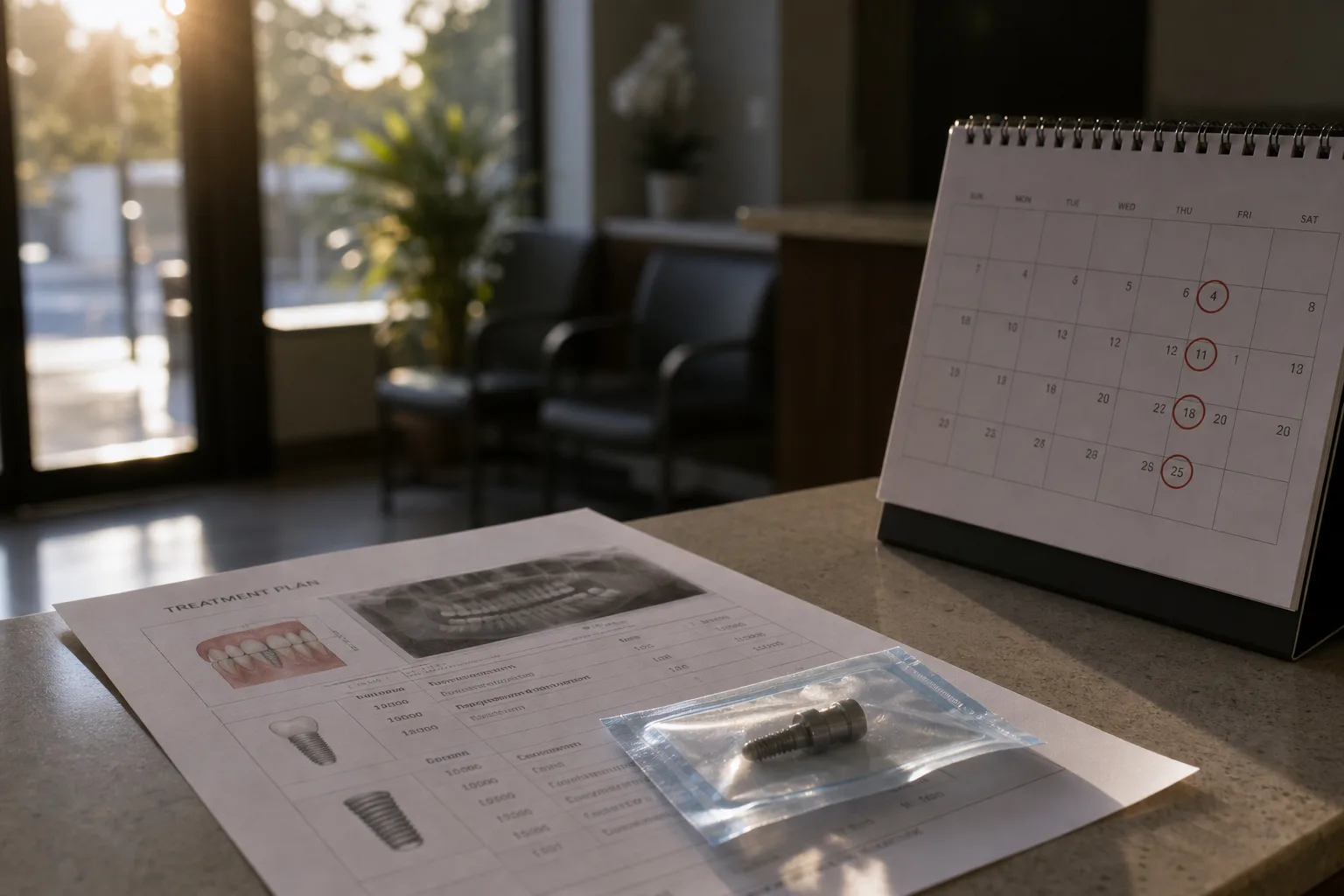
A course of treatment is quoted as a price, but it behaves like a schedule. The number on the treatment plan is a sum of fees, each attached to an appointment, and the appointments are attached to healing time, lab turnaround and whatever the supplier can ship. Move one date and the arithmetic that surrounded it stops holding. The case worth walking through is an ordinary one, a single molar implant with a bone graft in a general practice, because it contains every mechanism that changes the number without anyone changing their mind about the clinical plan.
The plan was four appointments, and only two of them had firm dates
The written plan listed extraction with a socket graft, a healing interval measured in months, implant placement, another healing interval, then impressions and a final crown on a custom abutment. Two of those visits could be scheduled the day the plan was signed. The others were conditional, dependent on radiographic healing and on a laboratory delivering a milled component. Patients read the total and hear a price. Practices write the total and mean a sequence, which is why the coordinator's estimate carried a validity window, and why that window was shorter than the treatment itself.
That mismatch is the whole story. A plan that spans eleven months is being priced with fees that are guaranteed for ninety days, and reimbursed by a dental benefit plan whose annual maximum resets on a date nobody at the front desk controls. The clinical decision was made once. The financial decision was, in practice, made three separate times, at extraction, at placement and at delivery of the crown, because each of those visits met a different fee schedule and a different remaining balance on the patient's benefit year.
Where the delay actually started, three weeks upstream
The graft material specified at the consultation was on allocation from the distributor, a common enough condition with allograft and xenograft particulate, and the practice took a substitute from a different manufacturer at a different unit cost. That substitution was clinically unremarkable and financially small. The larger disruption came later: the implant system's custom abutment blank was backordered at the milling center, and the lab, which does not hold inventory it cannot bill for, quoted an eight-week turnaround instead of the usual two. Nothing about the mouth had changed. The calendar had.
The Food and Drug Administration regulates dental implant components and graft materials as medical devices, which is why a practice cannot simply source an equivalent part from whatever is on the shelf when a manufacturer's line runs short; the abutment has to mate with the fixture that was already placed, and the fixture was chosen eight months earlier. That is the supply-side trap in staged care. The commitment happens at surgery, the exposure appears at restoration, and the interval between them is long enough for a distributor's allocation policy to change twice.
The same plan, priced differently two hundred miles away
A colleague in a neighboring state would have written the identical clinical sequence and arrived at a different total, for reasons that have nothing to do with what either practice thinks the work is worth. State boards set the permit tiers for sedation, and where a moderate sedation permit obliges a second credentialed person in the operatory for the whole appointment, that staffing cost lands inside the surgical fee. Scope of practice differs too: states that license expanded function dental assistants to place and finish certain restorations shift chair time off the dentist's hourly cost and onto a lower one.
Local rules reach further than most patients expect. Some states apply sales tax to prosthetic devices and some exempt them, which moves the crown line by a percentage point or two. Medicaid adult dental coverage is a state election, so the volume of self-pay work in a market, and therefore the practice's willingness to hold a fee, varies across a county line. Workers' compensation and no-fault fee schedules, where they apply, are set at the state level and become the reference price that commercial plans in that market negotiate against. Two honest quotes, two different states, one procedure code.
Who carried the eight weeks
The crown was delivered in January rather than November. The surgical phase had consumed most of the prior year's annual maximum, and the restorative phase now fell into a fresh one, which in this case worked in the patient's favor: two maximums instead of one, less out of pocket in total, though the money left the household across two tax years and two deductibles. Had the sequence run the other way, with the expensive restoration crowding a maximum already spent, the same delay would have cost the patient real money for no clinical reason.
The practice absorbed something too. It had quoted a fee that expired, and it honored it, because withdrawing a number after a patient has already been through surgery is the kind of thing that ends a relationship and invites a board complaint. The lab held its price for the original quote and applied its current schedule to the replacement blank. Nobody behaved badly. The cost of the interruption simply settled wherever the paperwork left it undefended, which is usually the party that wrote the softest sentence.
The sentences that decide it in advance
Three things in the treatment plan determine who pays for a delay, and all three are writable before the first appointment. The first is how long the quoted fees hold, stated in months rather than as a boilerplate ninety days, with an explicit note that the window covers the full staged sequence. The second is what happens if a component is substituted, whether the patient is told, and whether a price difference passes through. The third is the benefit year, named by date, with the practice's stated intention about which side of it each phase should land on.
Practices that write those sentences find the conversation easier when the backorder arrives, because the answer has already been agreed and does not have to be negotiated with someone who is halfway through a course of care. Patients who ask for them get a document that is useful rather than decorative. For anyone quoting staged treatment, the good-faith estimate given to self-pay patients under federal rules is the natural place to put all three, since it is already the document both parties will reach for when the schedule slips.
The clinical plan in this case never changed. What changed was a distributor's allocation, a milling center's queue, and the date a benefit year turned over, and those three things between them moved the patient's share more than any fee negotiation would have. Ask the practice when the parts are ordered, and from whom, before you ask what the crown costs.
Further reading
- . Booking a Facelift for the Quiet Season? What the Consultation Tells You Before the Deposit.
- . Four Documents, One Clinic Visit. Which One Actually Tells You What You Were Charged For.
- . Quoted a Course of Treatment? Three Ways the Price Is Built, and What Moves It.
- . A Backordered Furnace and a Substituted Model. Which Papers You Keep, and For How Long.