A Backorder Upstream, a New Face in the Room. Which Credential Actually Covered It
Abstract. A supply delay changed the implant system and the operator on a scheduled procedure, and it exposed which license, which privilege and which vendor contract were actually holding the risk.
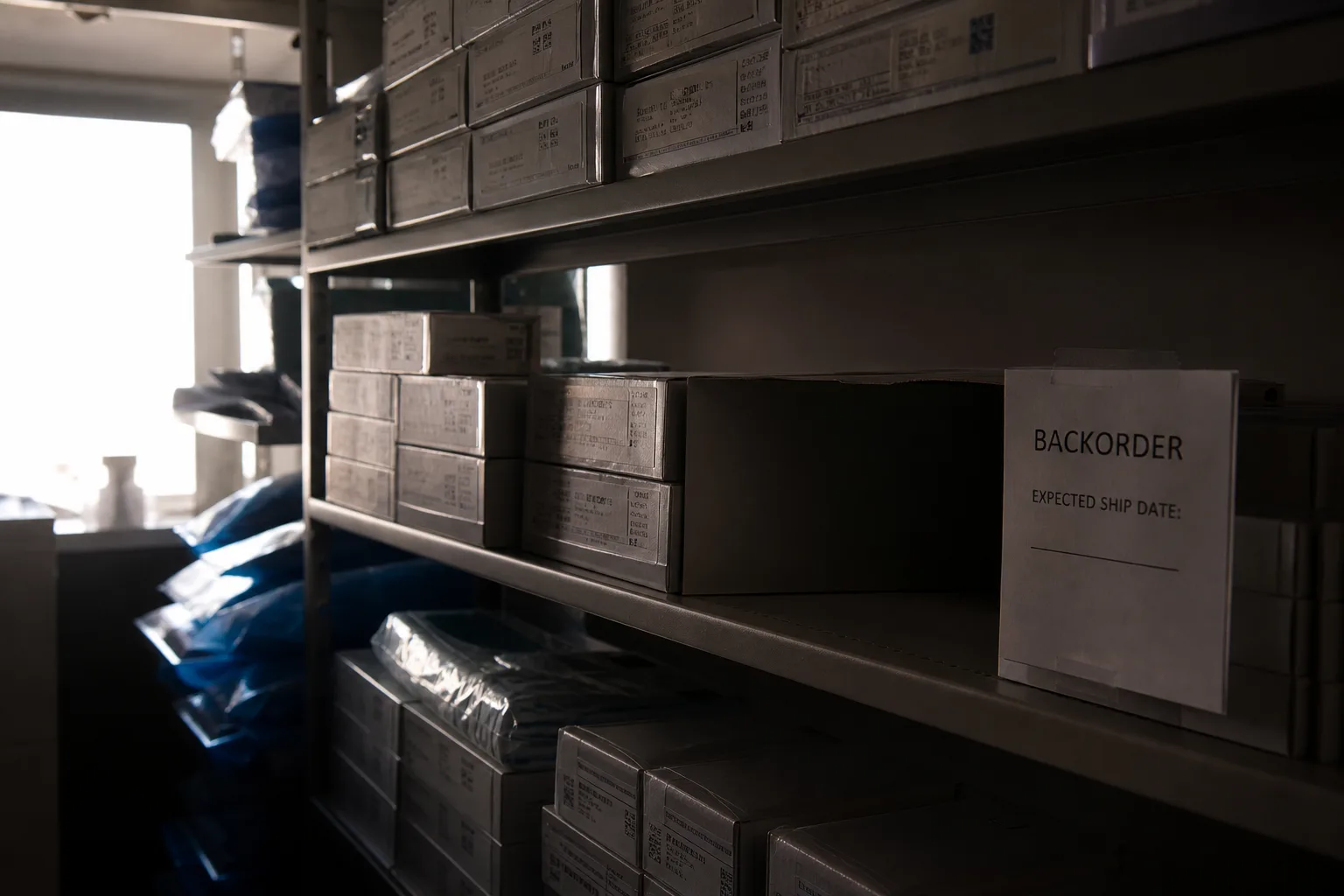
The case that follows is a composite, assembled from the way these jobs commonly fail rather than from one patient's file, and it is useful precisely because nothing in it was unusual. A single-tooth implant was scheduled eleven weeks out, quoted as a fixed package, and confirmed twice. Nine days before the date, the distributor told the clinic the abutment line was on allocation. The clinic did what clinics do under a scheduling constraint: it kept the date, changed the parts, and changed the hands. The patient was told about the first change and not the second.
What a backorder does to a calendar three weeks downstream
Supply pressure rarely announces itself as a shortage. It arrives as a substitution offer from a distributor rep who has an equivalent component in stock, shipping tomorrow, at a similar cost. The clinic accepts because the alternative is releasing a block of operatory time it has already staffed. That decision is defensible on its own terms. What it also does, quietly, is move the procedure onto a system the treating provider has placed less often, which is the moment a clinic starts looking at who on the roster has the most hours on that particular platform.
In this case, the answer was nobody on the permanent roster. The clinic brought in a provider through a locum agency, credentialed by that agency, licensed in the state, and unknown to the patient until the morning of the appointment. The date held. The quote held. The chain of responsibility did not hold in the same shape it had eleven weeks earlier, and no document the patient had signed described the new shape.
Four credentials were in play, and they cover different things
The state license is the floor. It says a named individual met an education and examination standard and has not been disciplined off the register, and it is verifiable in an afternoon through the licensing board's public lookup. Privileging is separate: it is the facility deciding which procedures that individual may perform on its premises, and it can be narrower than the license by a wide margin. Agency credentialing is a third thing, a contractual promise from the staffing company to the clinic that primary source verification was done. Manufacturer training certification is a fourth, and it is the one that actually maps to the substituted component.
A patient asking whether the provider is licensed will get a truthful yes that answers almost none of this. The license did not change when the parts changed. The relevant question was whether the operator had documented training on the substituted system and whether the clinic's privileging language was written by product or by procedure. Most privileging language is written by procedure, which is the sensible way to write it, and which is also why a component swap can pass through without triggering a single internal review.
The party nobody in the room was thinking about
The overlooked party is the staffing agency, and behind it, the distributor. Neither meets the patient, neither signs the treatment plan, and both of them are holding real risk allocation. The agency's contract with the clinic says who verifies the license, who carries the malpractice coverage, whether that coverage is claims-made or occurrence, and what happens to the tail if the placement ends. Occurrence coverage responds to the incident whenever the claim arrives. Claims-made coverage responds only if the policy is live when the claim is filed, which is a live problem for a provider who worked three days at a clinic two years ago.
The distributor's role is narrower but not trivial. It supplied the substitution, it may have supplied the compatibility assurance, and the Food and Drug Administration is the authority responsible for how medical devices are cleared and how recalls and adverse events are handled once a device is in circulation. That gives a patient a real place to look when a component's history matters. It also means the substitution question has a documentary answer: what was implanted, by lot, is recorded, and that record is the thing worth requesting.
The questions that work before the date, not on it
Ask, at the consultation, who will perform the procedure and what happens to the appointment if that person becomes unavailable. Ask whether the operator is employed by the practice or placed through an agency, and if placed, who carries the coverage and on what basis. Ask what components are being used and what the clinic's policy is on substitution, specifically whether a change of system triggers a call to the patient. Then ask for the implant record after the fact, with lot and manufacturer, and keep it. Four questions, all answerable in a normal appointment, all far cheaper to ask early.
Practices that have thought this through answer briskly, because they have already written the substitution policy and already know which coverage the agency carries. The answers are the useful signal. A clinic that can tell you, in November, what its December parts position looks like is a clinic managing the same risk you are.
Further reading
- . Booking a Facelift for the Quiet Season? What the Consultation Tells You Before the Deposit.
- . Four Documents, One Clinic Visit. Which One Actually Tells You What You Were Charged For.
- . Quoted a Course of Treatment? Three Ways the Price Is Built, and What Moves It.
- . A Backordered Furnace and a Substituted Model. Which Papers You Keep, and For How Long.