A Winter Substitution, a Spring Complaint. Which Records Still Prove What Happened
Abstract. Cold-season substitutions surface months later. What proved them ten years ago was a paper ticket; what proves them now is scattered across four apps and one supplier portal.
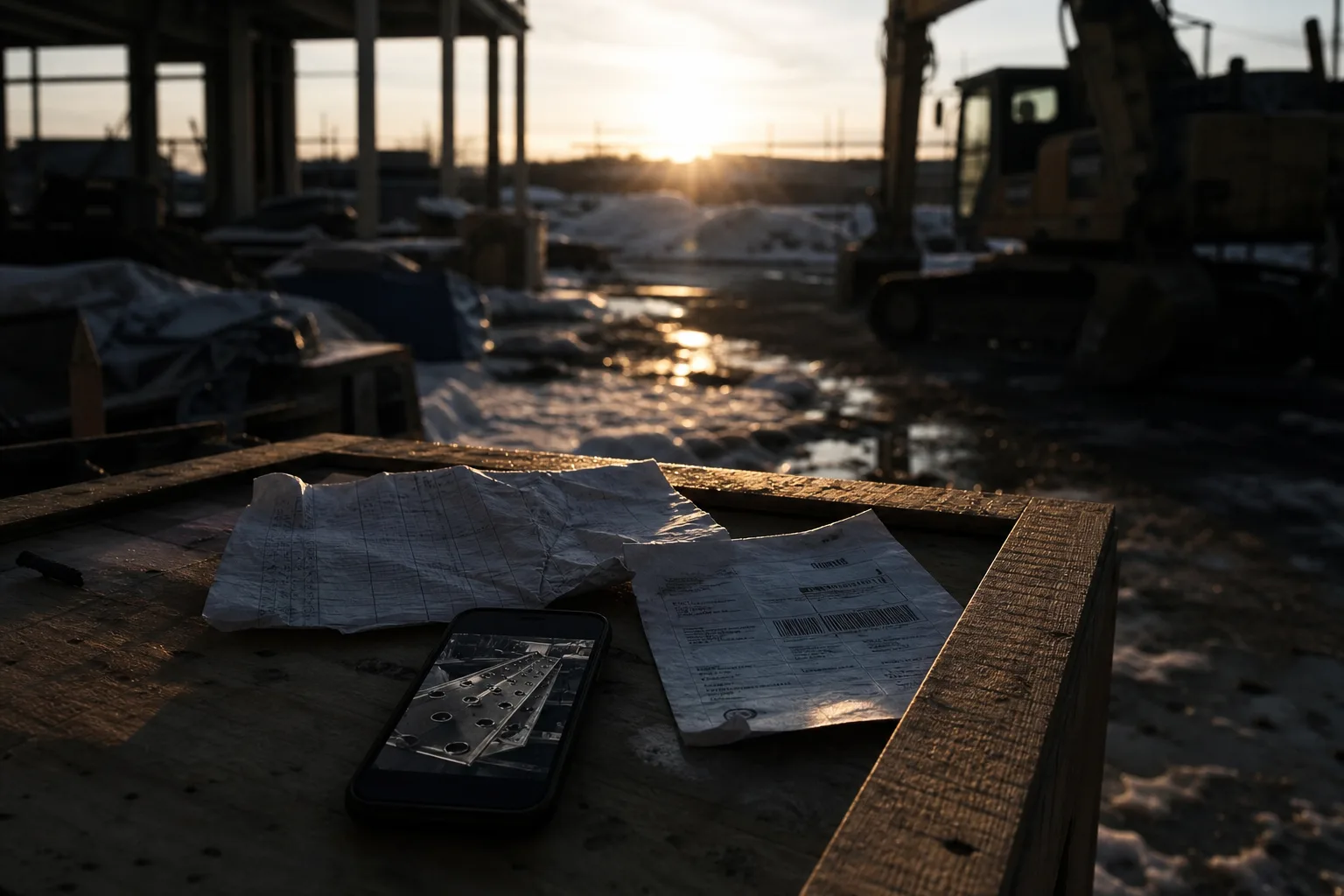
Substitutions cluster in the cold months, and not because anyone is cutting corners. A specified fixture goes to a fourteen-week lead time in November, the crew has a framed opening and a weather window, and something similar arrives on Thursday's truck instead. The decision gets made on a jobsite in eleven degrees, verbally, by two people who both understood it the same way at the time. The complaint arrives in May, when the homeowner reads the warranty card and finds a model number that does not match the contract. What settles that gap is whatever record survived the winter.
The week-to-week shape of a cold-season substitution
Upstream delays do not land evenly. A backorder announced at a distributor on a Monday reaches a scheduling problem three weeks later, by which point the general contractor has already committed the electrician, the drywall crew and the inspection date. The substitution is rarely a choice between the right part and a worse one. It is a choice between a worse part on Thursday and an idle crew until February, with a deposit already drawn and a subcontractor who will not hold the slot. That pressure is real, it is seasonal, and it explains why so many disputes trace back to a single unrecorded conversation in a driveway.
The risk in that moment sits almost entirely with the homeowner, and usually without their knowledge. The contractor absorbs a schedule problem. The homeowner absorbs a different product, a different service life, and a manufacturer warranty that may attach to a model nobody agreed to buy. Warranty disclosure in consumer transactions falls under the Federal Trade Commission, which is worth knowing when the registration card and the contract disagree, because the document that governs the repair is the one printed by the manufacturer, not the one signed at the kitchen table.
What the record looked like ten years ago
A decade back, the paper trail was thinner and, in one narrow respect, stronger. A delivery came with a carbon-copy ticket, someone signed it, and a copy went in a binder in the truck. Substitutions tended to produce a handwritten change order, because there was no faster way to communicate one. The record was incomplete, often illegible, and frequently lost, but what did exist was singular: one ticket, one signature, one date, and no competing version of the same event sitting in a different system. Disputes turned on whether the document existed, not on which document controlled.
What the record looks like now
Now the same substitution generates a dozen traces and no single authority. There is a text thread, a project management app where the change was marked approved by a login rather than a person, a supplier portal showing the original item as canceled, an email from a distributor about allocation, and a photograph on somebody's phone. Volume is not the problem. The problem is that app threads get archived when a subscription lapses, portals show current status rather than history, and a message marked approved proves only that a button was pressed by whoever held the credentials that week.
The evidence that still holds up has the same three properties it always did. It is dated by something other than the sender's own memory, it names the specific item rather than the category, and it exists in a place the other party does not control. A photograph of the shipping label on the crate that actually arrived does all three at once. So does a short email, sent to yourself as well as the contractor, confirming what was agreed on the phone that morning. What fails is the screenshot with the timestamp cropped out and the recollection of a conversation neither party wrote down.
The habit that costs ten minutes a week
The practical version is unglamorous and it fits into an ordinary Friday. Photograph every label, spec sheet and model plate before packaging goes in the dumpster, because packaging leaves the site fast in winter when the yard is a mess. Keep the delivery tickets, even the crumpled ones. Then send one email a week, plainly written, listing what arrived, what got substituted and what remains outstanding, and ask for a correction rather than an acknowledgment. Silence against a specific written list is worth considerably more, months later, than a signature on a document nobody read.
That weekly email also does something useful before any dispute exists. It surfaces the substitution while the crew is still on site, while the wall is open, and while a supplier still has an allocation to reroute. Most substitutions caught in week two are solvable at no cost to anyone. The ones that become complaints are the ones discovered in spring, after the tile is grouted and the trim is painted, when the only remaining remedy is money and the only remaining question is who can prove what was ordered.
Winter will keep producing substitutions for as long as lead times swing with the season, and the crews making those calls are mostly making reasonable ones. The change worth adapting to is that the burden has shifted from finding a record to choosing among several, and the record that wins is the boring one: dated by a third party, specific about the item, and stored somewhere you can still reach next June.
Further reading
- . Asked Your Landlord for a Ramp and Been Refused? What the Legal Quote Actually Covers.
- . Winter Damage, Thin Proof? The Dated Records Someone Else Is Already Keeping for You.
- . Quoted an Hourly Rate? What That Number Is Attached To, Week by Week.
- . Quoted a Flat Fee for Legal Work? What That Number Is Actually Measured Against.