Winter Damage, Thin Proof? The Dated Records Someone Else Is Already Keeping for You
Abstract. Cold-season disputes turn on provenance, not volume. The strongest file usually contains documents created by a third party who has no stake in the outcome.
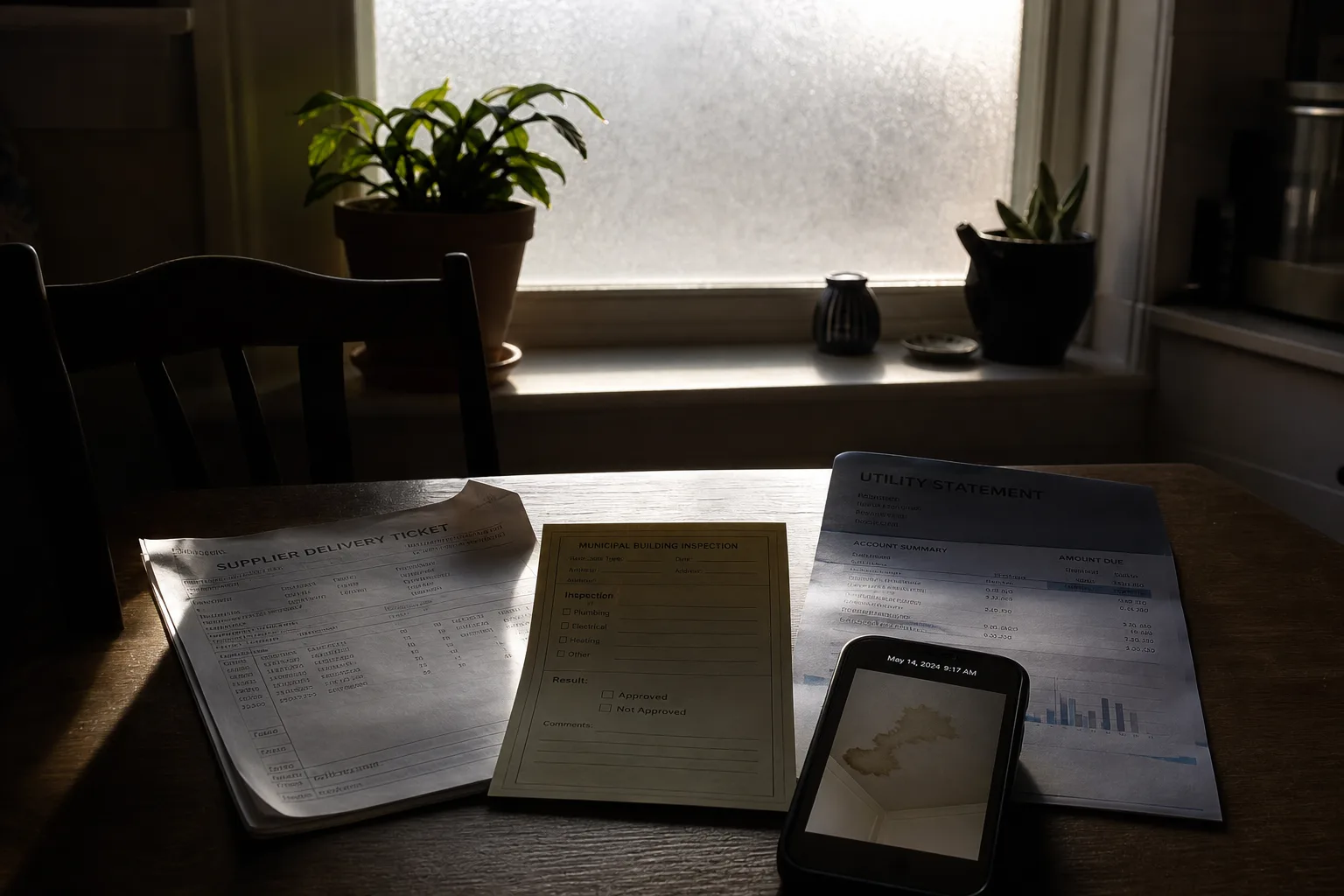
A homeowner holding four hundred phone photographs usually has a weaker file than one holding three photographs, a supplier delivery ticket and a permit inspection card. Volume is not the variable. What decides a disputed claim, a chargeback, a licensing board complaint or a small claims hearing is whether a document can be dated, located and traced to someone who had no reason to shade it. Cold weather sharpens that distinction, because the physical condition you are arguing about frequently melts, refreezes or gets shoveled away before anyone neutral looks at it. The paper outlives the ice.
The assumption is that documentation means your own documentation
Most people preparing a complaint reach first for what they personally created: photographs, a running note on the phone, a recollection of what the crew lead said on the driveway. That material has a role, but it is weak in the way all self-generated evidence is weak, because the other side can question when it was made and why. An undated close-up of a stain proves a stain existed at an unknown moment. The same photograph, paired with a timestamped email you sent that afternoon describing the stain, becomes a contemporaneous record, and contemporaneous is the quality that actually carries weight.
The upgrade is cheap and takes minutes. Convert conversations into writing the same day, addressed to the other party, in neutral language: confirming that you were on site at two o'clock, that the hose bib was reported as frozen, that the foreman said the valve would be replaced Thursday. You are not trying to win the email. You are creating a dated document that the other side received and did not correct, which is a different and far more durable thing than a note only you have ever seen.
What the season does to the thing you are arguing about
Winter rewrites causation faster than any other season. An ice dam that lifted shingles leaves a wet ceiling and almost no visible roof condition once a warm week passes, and a slab crack that opened during a hard freeze reads very differently in April than it did in January. Insurers and contractors both know this, and the argument that arrives is usually about sequence rather than existence: the damage is conceded, the cause is not. Evidence that fixes a date onto a physical condition is therefore worth several times more in December than in June.
This is where outside observational records earn their place. The National Weather Service is responsible for the official observational record in the United States, and the local station history for the days around a loss is public, retrievable and not created by anyone in your dispute. A sustained freeze on specific dates, followed by a thaw, supports a causation story in a way your own account cannot. Pair that with the first dated photograph you took and you have bracketed the event between two independent sources, which is the shape adjusters and hearing officers find persuasive.
Heating season also makes certain complaints provable precisely because the equipment is running. A furnace that short cycles, a zone that never reaches setpoint, a heat pump locked into auxiliary strip heat: all of this is measurable right now, with a thermostat log, a utility interval report, or a service technician's written readings. The same complaint raised in May becomes an argument about memory. If the dispute concerns heating performance, the window for building a clean record closes when the thermostat does.
The party nobody thinks to ask, and what they are already holding
The overlooked participant in almost every consumer dispute is the third party who was not a party at all: the supplier, the permit office, the manufacturer, the utility, the lender, the credentialing board. None of them are on anyone's side, which is exactly why their records travel well. A lumberyard delivery ticket dates materials to a job site. A building department inspection card records who called for which inspection and on what day, and whether it passed. A manufacturer's serial number lookup establishes the model and production date of the unit actually installed, which is the fastest way to settle a dispute over whether you received what the contract specified.
Utility interval data is the least used of these and often the most decisive, because it shows consumption in short increments and can corroborate when a system started misbehaving or when a vacant property lost heat. Bank and card records establish payment dates against promised milestones. Each of these documents was generated by an organization with no interest in your outcome, in the ordinary course of its own business, and that provenance is the whole point. Request them early, in writing, and keep the request itself, because a refusal is also a dated fact.
Credentials are evidence, and the date on them is the part that matters
A license lookup that shows a contractor in good standing today tells you nothing useful if the work happened fourteen months ago. What matters in a dispute is status on the date of the work, and state boards maintain that history even when the public search page shows only a current snapshot. Most boards will produce a certified license history on request, listing issue dates, lapses, renewals, disciplinary actions and the name of the qualifying individual. Year end complicates this, because many renewal cycles turn on December 31, and a license that lapsed briefly over the holidays is a fact that only an archived record will surface.
Confirm the credential against the contract, not against the truck. The number on the proposal should match a person or entity whose legal name matches the party you paid, and if the qualifying agent named on the license is not involved in your job, that gap is worth noting in writing. Memberships and certifications deserve the same treatment: ask what the body actually vets, whether it verifies insurance and testing or simply collects dues, and verify membership directly with the organization rather than from a logo. A manufacturer certification can usually be confirmed by the manufacturer in a phone call.
Insurance follows the same logic. A certificate of insurance proves a policy existed on the day the certificate was issued, which is not the same as coverage on the day of the loss, so request confirmation from the agent named on the certificate that the policy was in force across the relevant dates. Workers compensation coverage matters for anyone injured on your property, and general liability matters for damage to the structure. These are short calls, and the written answers become part of a file that tends to settle disputes before anyone files anything.
Build the file while the season is still producing the evidence. A cold month generates dated, independent records almost automatically, in utility meters, weather stations, delivery logs and inspection cards, and the work of collecting them is far smaller in January than the work of reconstructing them in July.
Further reading
- . Asked Your Landlord for a Ramp and Been Refused? What the Legal Quote Actually Covers.
- . Quoted an Hourly Rate? What That Number Is Attached To, Week by Week.
- . Quoted a Flat Fee for Legal Work? What That Number Is Actually Measured Against.
- . Tight Budget, Weak File? Where Your Evidence Fails and Which State Rule Decides It.