Tight Budget, Weak File? Where Your Evidence Fails and Which State Rule Decides It
Abstract. Most household disputes are lost on evidence that was free to collect and never collected properly. What holds up, what a state line changes, and what to pay for first.
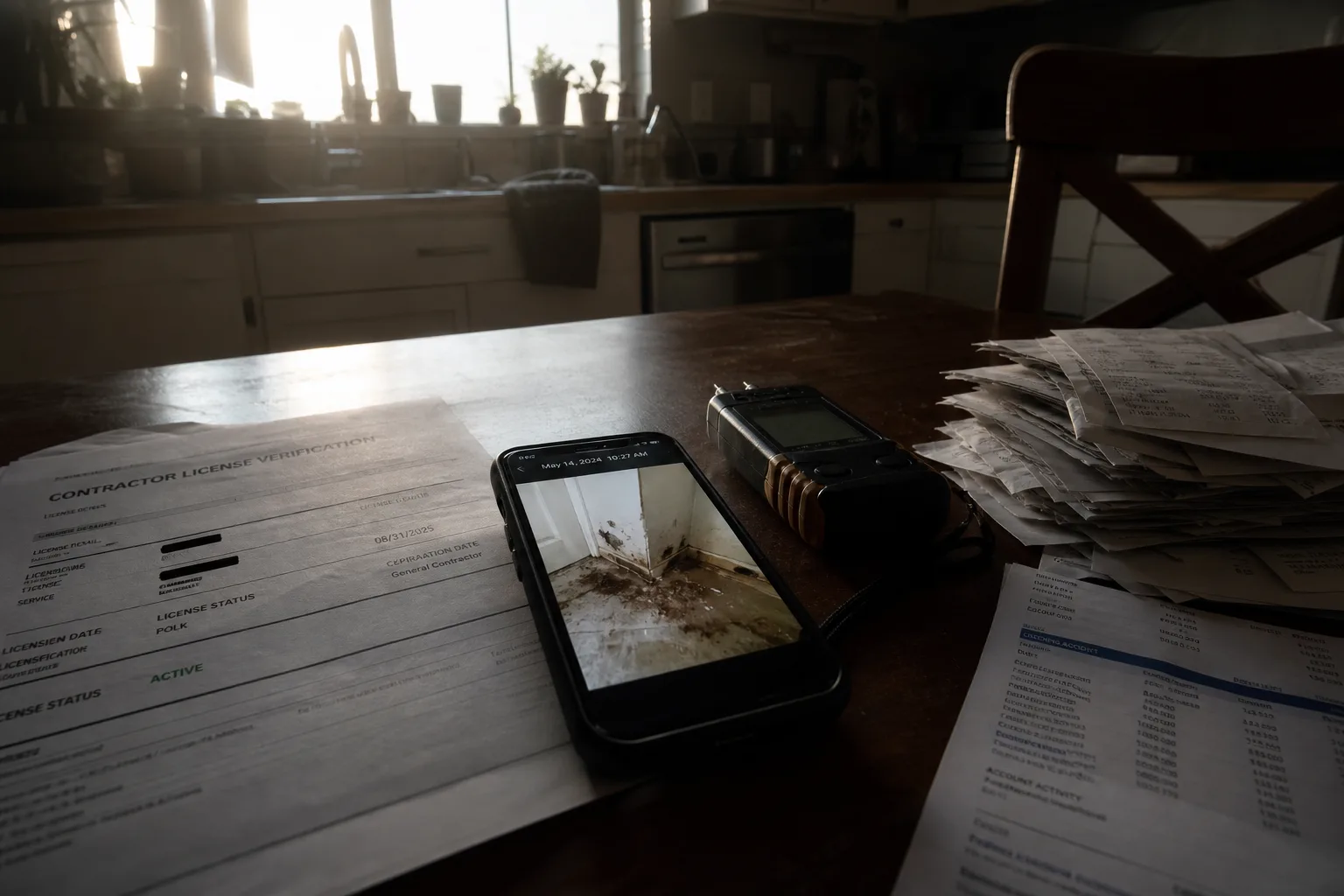
The file that decides a consumer dispute is usually assembled after the argument starts, which is exactly why it fails. By then the photographs have no dates anyone trusts, the important agreement was made standing in a driveway, and the person who promised to fix it has stopped answering. The consequence people rarely trace back is not losing in court. It is being unable to get a claim taken seriously at all: an insurer closes it, a licensing board declines to open a case, a card issuer sides with the merchant, and none of them explain that the problem was evidentiary.
What actually holds up is dated, attributable, and made before the fight
Three qualities separate evidence that survives scrutiny from evidence that merely feels convincing. It must be dated by something other than your memory, attributable to a named person rather than a company in the abstract, and created before you had a reason to shade it. A text message asking a contractor to confirm Thursday's start satisfies all three. A summary you type up in month four satisfies none of them, however accurate it is. This is why contemporaneous notes matter more than eloquent ones, and why a boring one-line email sent the same afternoon outperforms a detailed account written from memory.
Photographs are the most common failure. Phone images carry embedded date and location data, but that data is stripped when the picture travels through some messaging apps and is easily altered, so a photo alone proves less than people assume. What repairs it is context: the same shot from the same position on multiple dates, a newspaper or a phone screen showing the date in frame, or the image attached to an email whose server timestamp nobody controls. Send your photos to yourself the day you take them. That single habit costs nothing and converts a weak exhibit into a dated one.
The rules that change at the state line
Recording is where confident people get hurt. Roughly a dozen states require every party to a conversation to consent before it is recorded, while the rest allow recording if one participant, meaning you, consents. In a two-party state, a secretly recorded call with your contractor is not just inadmissible in a private dispute; making it can expose you to civil liability and, in some jurisdictions, criminal exposure. The safe move works everywhere: say at the start that you are recording and ask the other person to confirm on tape. If they refuse, hang up and send an email summarizing what was said instead.
Notice rules vary just as sharply and carry harder deadlines. Many states have right-to-cure statutes that require a homeowner to give a contractor written notice of defective work and a defined window to inspect and repair before any lawsuit is filed, and skipping that step can get a case dismissed no matter how strong the underlying facts are. Small claims ceilings, service requirements, and the deadline for demanding arbitration also differ by state and sometimes by county. Read your own state's rules, not a national article, before you send the letter that starts the clock.
The free third-party records most people never pull
Evidence you did not create is worth more than evidence you did, and a surprising amount of it is public. Your municipal building department holds the permit history for the job, including whether a permit was pulled at all, who pulled it, and which inspections passed or failed on which dates. State licensing boards publish license status, expiration, bond and insurance filings, and prior disciplinary actions, and most let you print a dated verification page. The Federal Trade Commission oversees deceptive practices in consumer transactions and maintains a complaint intake that produces a reference number, which is itself a dated record that you raised the issue when you say you did.
Add the ordinary paper trail that already exists in your own accounts. Bank and card statements fix payment dates and amounts, utility bills show a spike in the month a system failed, and the National Weather Service archive establishes whether it actually rained on the day the roof leaked. Certificates of insurance can be confirmed by calling the carrier listed on the form rather than trusting the PDF. Each of these has an author with no stake in your dispute, which is precisely why an adjuster or a judge weighs them differently than your own account.
Where a limited budget buys the most
Spend first on measurement, not opinion. A moisture meter reading, a second contractor's written estimate that describes the defect rather than just quoting the repair, or a single billed hour from a licensed inspector produces a document with a credential behind it. Verify that credential yourself before you pay: check the license number against the state board, confirm the name matches the person doing the work, and ask what the certification actually tested. A full engineering report is expensive and is worth it mainly when the money at stake clearly exceeds it. Below that line, three dated photographs and one verified professional's written observation do most of the work.
The households that come out ahead are rarely the ones with the best story. They are the ones who, in the first week, sent one email, took one dated photograph, and printed one license verification, before anyone knew there would be a dispute at all.
Further reading
- . Asked Your Landlord for a Ramp and Been Refused? What the Legal Quote Actually Covers.
- . Winter Damage, Thin Proof? The Dated Records Someone Else Is Already Keeping for You.
- . Quoted an Hourly Rate? What That Number Is Attached To, Week by Week.
- . Quoted a Flat Fee for Legal Work? What That Number Is Actually Measured Against.