Breach Letter Over the Holidays? The Steps You Can Finish Sitting Down
Abstract. A breach notice that lands in December meets a different calendar than one that lands in June, and the paperwork it triggers can mostly be done from a chair.
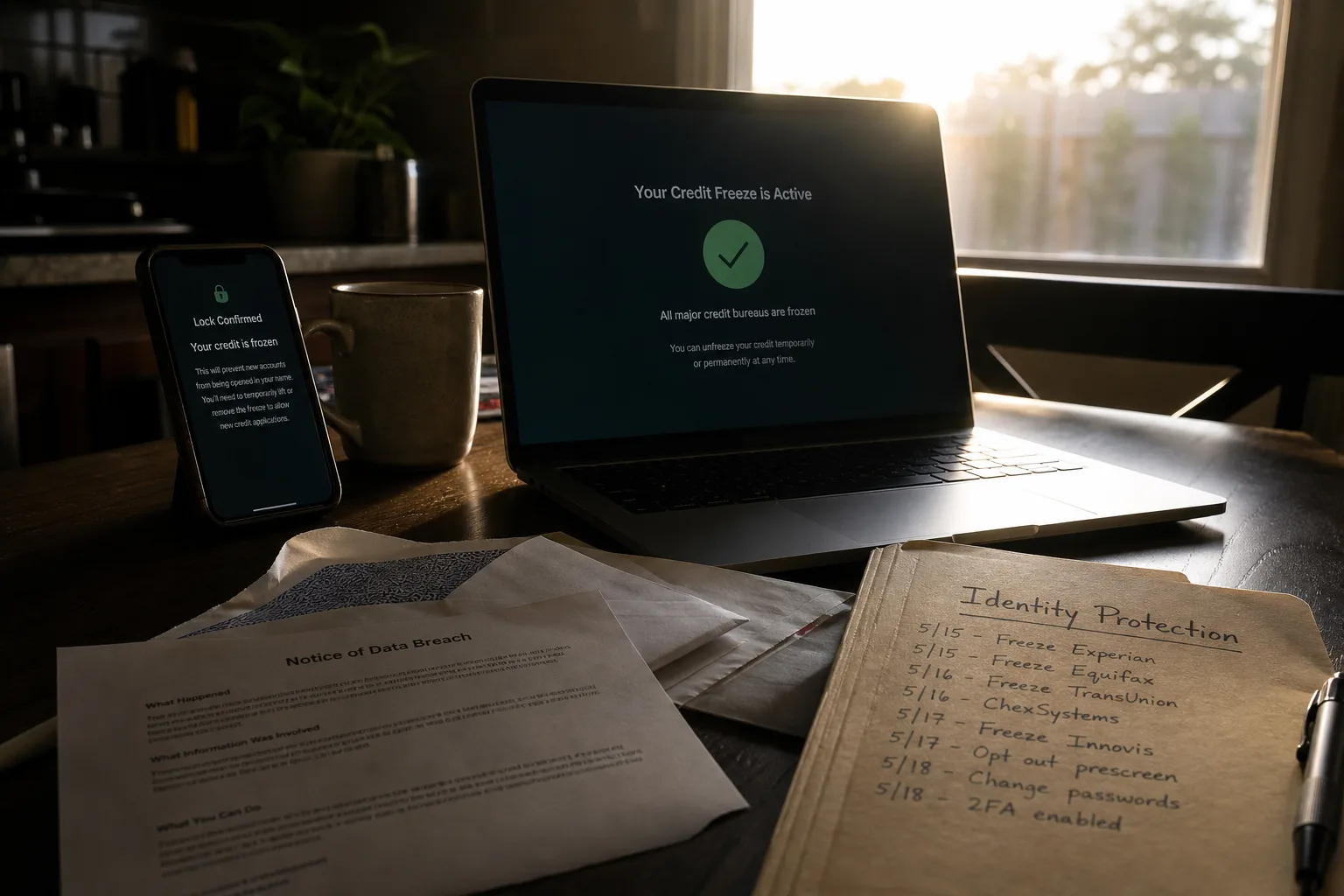
A breach notification is a piece of mail with a clock attached, and the clock runs at a different speed depending on the month it arrives. The letter itself rarely says so. It describes what was taken, offers a monitoring enrollment code, and gives a deadline for activating it, all in the same flat register whether it reaches you in June or the week before Christmas. What changes with the season is not the exposure but the collision: the number of card transactions you are about to make, the tax return that has not been filed yet, the open enrollment window, the pharmacy switching your plan year. The work is the same work. The consequences of postponing it are not.
The December letter and the February letter ask for different things first
A notice that lands in the middle of holiday spending arrives while your card numbers are moving through more merchants than at any other point in the year, which makes a stolen card number harder to trace back and a fraudulent charge easier to miss inside a long statement. The useful first move is narrow: turn on transaction alerts for every card in the household, set the threshold low, and read the statement line by line once rather than skimming it three times. A notice that lands in January or February sits against a different risk, which is somebody filing a return in your name before you file yours. Same letter, different opening step.
The tax version of the problem has a specific remedy that costs nothing and takes a browser. The IRS runs an Identity Protection PIN program, a six-digit number that must appear on an electronically filed return for it to be accepted, and once you have one, a return filed without it fails. If your breach letter mentions a Social Security number, that program is worth opening the same week the letter arrives, not in April. Filing early is the companion move. The first return through the door is the one that gets processed, and the second one is the one that has to be argued about.
Late summer and early fall carry their own version. Enrollment periods for health coverage, benefits changes at work, and school registration all involve handing identifying information to systems you do not control, and a breach notice arriving in that window means the same data is in motion in two places at once. Nothing about the response changes. What changes is that you want the freezes in place before the enrollment forms go out, rather than after, because a freeze applied first is quiet and a freeze applied later means unfreezing to let a legitimate check through.
Most of the response is now a browser tab, not a counter
The part of this that used to require standing in line has largely moved. A security freeze at each of the three national credit bureaus can be placed online, is free by federal law, and can be lifted temporarily for a specific window when you need a lender or a landlord to pull your file. That last detail matters more than people expect, because a freeze is not a wall you have to dismantle every time; it is a switch with a timer. The Federal Trade Commission oversees identity theft reporting for consumers and maintains IdentityTheft.gov, which walks through a recovery plan and generates prefilled dispute letters based on what you tell it.
Those prefilled letters are the underrated tool. Writing a dispute from scratch means finding the right address, the right recitation of your rights, and the right tone, all of which is drafting work that a person managing pain, fatigue, or a screen reader should not have to do at eleven at night. The generated version arrives formatted and specific. Print it, sign it, and the only physical act left is getting it into the mail. For an account takeover rather than a credit file problem, the equivalent shortcut is your bank's secure message center, which produces a timestamped written record without a phone queue.
Phone trees deserve a plan of their own, because they are where the time goes. Written channels create their own paper trail. Where a call is unavoidable, ask at the start for a reference number and the representative's identifier, note the date and the length of the call, and ask them to send a written confirmation of whatever they just agreed to. Callback queues that hold your place without holding the line are worth choosing every time they are offered.
The folder that makes month four survivable
Keep the envelope. The postmark establishes when notice reached you, and the letter itself names the incident, the date range, and the categories of data involved, which is the language every downstream institution will ask you to repeat. Put it in a single folder, physical or a labeled folder on your computer, and add to it in order: the enrollment confirmation for any monitoring offered, screenshots of each freeze confirmation, the FTC identity theft report if you file one, and a plain running log of dates, names, and what was said. One page of dated notes settles disputes that four separate memories cannot.
Scan as you go rather than at the end. A phone camera and a free scanning app turn the pile into searchable files without a trip to a copy shop, and email the folder to yourself so it exists somewhere other than the machine on your desk. If a bank later insists that you never reported the charge, or a bureau claims the freeze was never placed, the confirmation number in that folder ends the conversation in one message. The people who struggle in month four are almost always the people who threw away month one.
When the process still asks for a body in a building
Some steps resist the browser. Identity verification for certain government accounts may route to a video call or an in-person appointment, a police report for identity theft may want you at a station, and an affidavit may want a notary. Each has a workaround worth knowing before you are tired. Many departments accept identity theft reports online or by phone. Remote online notarization is recognized in most states and runs from a laptop. Mobile notaries travel to a home for a modest fee, and banks often notarize for customers at no charge, which is a short errand rather than a long one.
Where the work genuinely exceeds what you can do, hand part of it over deliberately. A written authorization on file lets a family member speak to a bank on your behalf, and for tax matters the IRS accepts a signed authorization allowing another person to discuss your account. Doing that in advance, while nothing is on fire, converts a three-hour call you cannot make into a call somebody else can. That is the difference between a breach that costs you a weekend and one that follows you into spring.
The letter is not the emergency. It is the notice that a window has opened, and the window closes on a schedule set by the season you are standing in: card traffic in December, filing in February, enrollment in October. Read the date on the envelope first, decide which of those three you are actually in, and take the one step that season rewards most. The rest can be done sitting down, in order, with a folder open.
Further reading
- . Breach Notices Arrive Earlier and Say Less. What That Changes About Your Costs.
- . The Notification Clock Slipped a Week. Where That Shows Up on the Invoice.
- . Got a Breach Letter and No Straight Answers? Who Wrote It, and Why Waiting Helps.
- . Your Breach Letter Is Dated in March and the Exposure Started in October. What Happened in Between.